
HK268G Mini vs HK868P Automatic Edge Banding Machine: Woodworking Machine Head-to-Head
HK268G Mini vs HK868P Automatic Edge Banding Machine: Woodworking Machine Head-to-Head
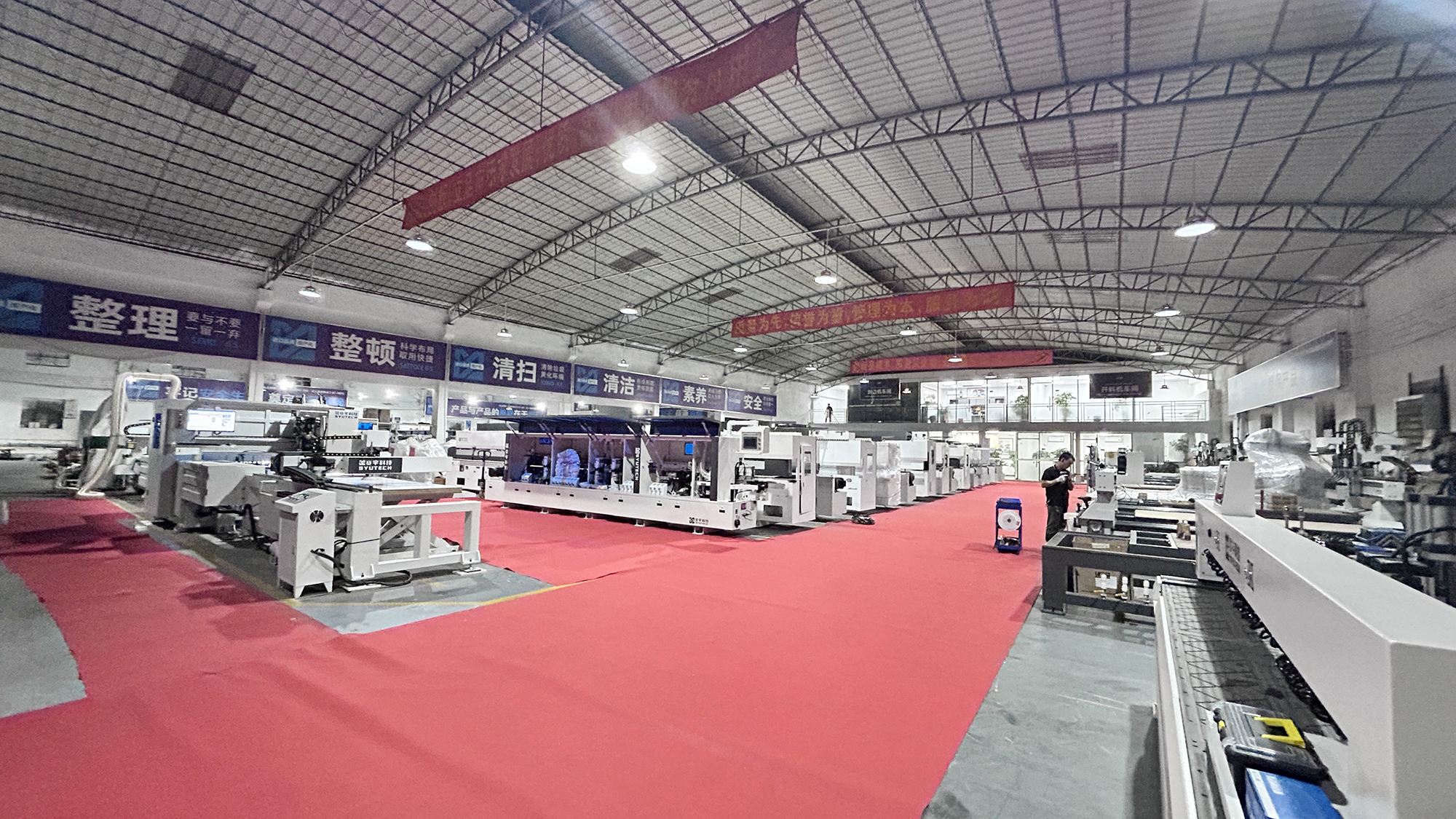
The HK268G and the HK868P are both edge banding machines from SYUTECH (Foshan Shunde SaiYu Technology Co., Ltd.), and both are specified for the same banding work: 10–60 mm edge band width, 0.35–3 mm band thickness, 16–22 m/min feeding speed and 0.7–0.9 Mpa pneumatic power on a 380V 50Hz supply. They separate on the physical asset. HK268G measures 3790 × 730 × 1210 mm and is built in carbon steel / SS304. HK868P measures 9500 × 1000 × 1650 mm, is built in carbon steel, and carries a 4T net weight.
Because the banding envelope is identical, this head-to-head is not a contest about which machine produces a better edge. It is a decision about which machine body matches your shop footprint, your material environment and your production volume — the three variables that decide an edge banding machine purchase in a panel furniture workshop.
The Problem: Same Banding Envelope, Opposite Machine Roles
A compact edge banding machine and an automatic edge banding machine are usually compared on price, footprint or “automation level”. None of those three answers the question a panel furniture shop actually faces: which machine keeps the edging cell fed without becoming either a bottleneck or an idle asset?
Both machines here are specified to band the same range — 10–60 mm edge band width and 0.35–3 mm band thickness — at the same 16–22 m/min feeding speed, using the same 0.7–0.9 Mpa pneumatic supply. A buyer who selects on banding capability alone has no selection criteria left. The real constraints are:
- Shop footprint and access. Whether the machine can be placed, loaded and later relocated in your building. A 3790 × 730 × 1210 mm machine and a 9500 × 1000 × 1650 mm machine are not interchangeable layouts.
- Material choice. Carbon steel versus carbon steel / SS304 construction, and how the workshop environment — humidity, PVC glue vapor, cleaning routine — affects long-term machine condition.
- Volume needs. How many panels per shift, how often the batch changes, and whether the edge bander is a standalone cell or the anchor of an automatic production line.
The expensive mistake runs in both directions. A shop buys the automatic machine for capacity it never reaches, and locks a 9.5 m machine with a 4T installation into an underused cell. Or a shop buys the compact machine for a volume profile that needs continuous throughput, and ends up with a permanent bottleneck at the edging stage.
Decision rule: if your binding constraint is space, mobility and batch changeover, the HK268G is the correct first machine. If your binding constraint is continuous volume and line integration, the HK868P is the correct anchor machine. If both constraints are real, the sequence — not the model — is usually the answer.
Industry Background: Why Edging Capacity Became a Line Decision
Woodworking machinery purchasing has shifted from single-machine buying to capacity planning, and the edge banding cell is where that shift shows up first.
- The global woodworking machinery market was valued at USD 20.3 billion in 2025 and is projected to reach USD 27.7 billion by 2033 (Grand View Research). Published estimates for this market vary widely by scope — some analysts count only secondary furniture machinery, others include primary wood processing — so any single figure should be treated as an order of magnitude rather than a precise budget line.
- Europe accounted for a 36.4% revenue share of the woodworking machinery market in 2025, driven by established manufacturers in Italy and Germany (Grand View Research).
- Asia Pacific held the largest share of the wood processing machines market at 34.5% in 2024, led by China and India (Credence Research).
- China’s exports of machine tools for working wood to Vietnam reached US$311.6 million in 2024 (UN Comtrade) — a reminder that panel furniture production capacity keeps moving toward lower-cost manufacturing regions, and machine demand moves with it.
- The automated edge banding machine segment has been projected to grow at a CAGR of 6.8% through 2030 (industry trend data; a projection, not a measured result).
Two structural facts sit underneath those numbers. First, the competitive frame is set by large international groups — Homag Group, SCM Group, Biesse Group and Weinig AG are consistently listed among the top global competitors in woodworking machinery — which means most buyers comparing machines are also comparing service distance, delivery terms and after-sales reach. Second, compliance is not optional: edge banding machines fed by chain(s) must comply with the EN 1218-4 safety standard for the European market, so machine documentation and configuration have to be checked before a unit is specified for an EU-bound order.
The practical consequence: on a modern panel furniture line, an edge banding machine is evaluated together with the machines before and after it — the computer panel saw and CNC nesting production line upstream, and the six side drilling machine, beam saw and drilling and milling center downstream. That is the context in which a mini edge banding machine and an automatic edge banding machine become two different strategic choices rather than two price points.
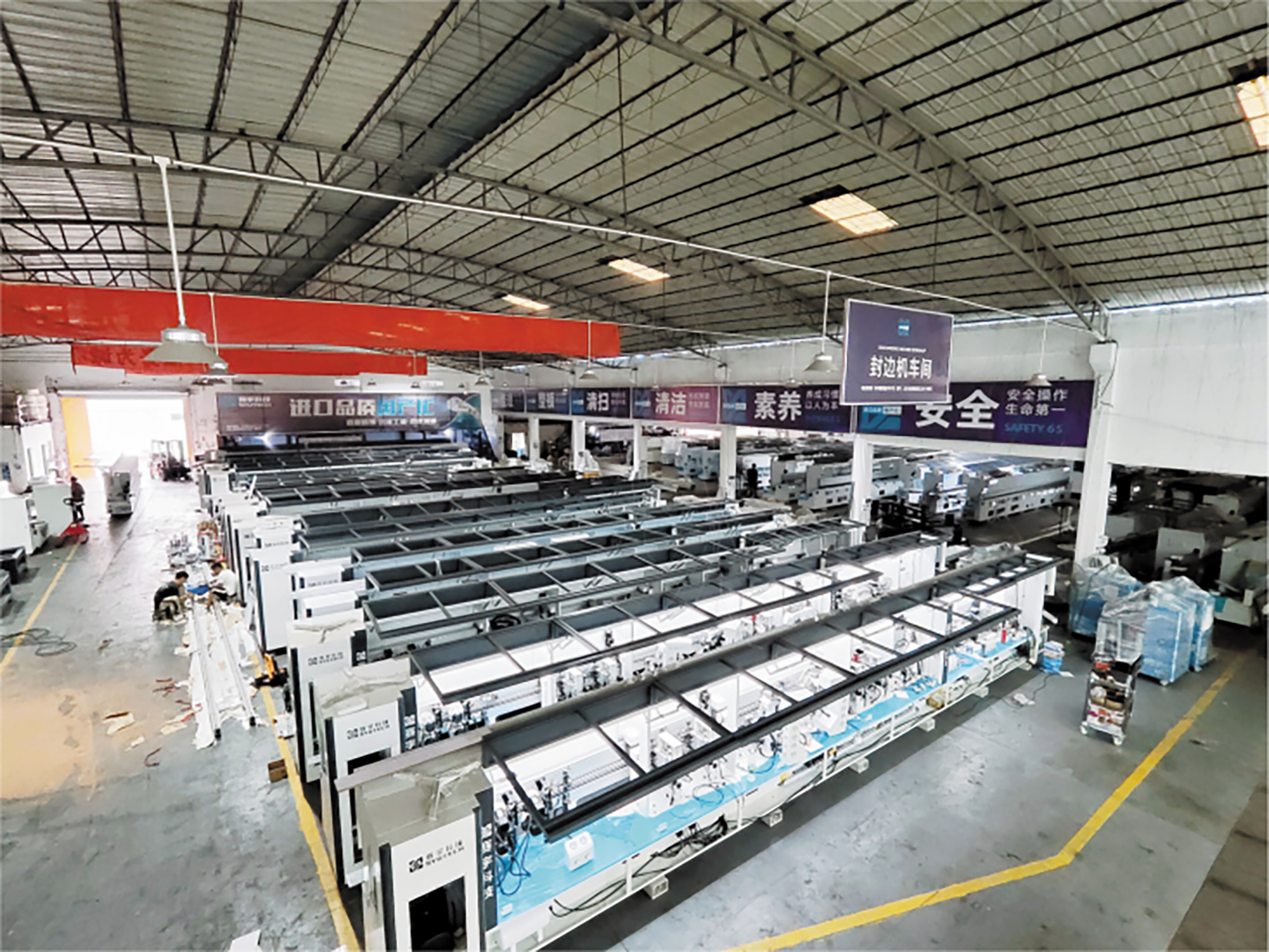
The Detailed Solution: What Each Machine Actually Is
HK268G: the compact, relocatable edge banding machine
The HK268G is a mini edge banding machine built around a 3790 × 730 × 1210 mm body. In real workshops, the 730 mm width and 1210 mm height matter more than the overall length: the machine fits into a narrow bay, against a wall, or into a small dedicated edging room, and it can be repositioned when a shop reorganizes its material flow.
Construction material is specified as carbon steel / SS304. That material choice is a buying criterion rather than a cosmetic detail — stainless steel surfaces are relevant in humid or coastal workshops, in buildings where PVC glue vapor and cleaning agents are present, and in operations where corrosion resistance on exposed surfaces is part of the maintenance plan.
Power supply is 380V 50Hz, and the banding envelope equals that of the automatic machine: 10–60 mm band width, 0.35–3 mm band thickness, 16–22 m/min feeding speed and 0.7–0.9 Mpa pneumatic power. A compact machine in this class is therefore not a reduced-capability machine in terms of the band sizes it can run.
HK868P: the automatic edge banding machine as a fixed line asset
The HK868P is an automatic edge banding machine with a 9500 × 1000 × 1650 mm body, carbon steel construction and a 4T net weight, on the same 380V 50Hz supply. Those numbers describe an installed asset rather than a movable unit: a 9.5 m machine with a 4T mass needs a planned foundation position, a floor loading assessment, and a level installation that will not be changed casually.
Its banding parameters match the compact machine: 10–60 mm edge band width, 0.35–3 mm band thickness, 16–22 m/min feeding speed and 0.7–0.9 Mpa pneumatic power. This is the machine that belongs at the center of a production layout, with material flow organized around it. For a shop executing a panel furniture line project, that is the correct role for an automatic edge banding machine: it defines the cell, and upstream cutting and downstream drilling equipment is planned around its position and pace.
What both machines share — and why that matters to the decision
- Edge band width: 10–60 mm
- Edge band thickness: 0.35–3 mm
- Feeding speed: 16–22 m/min
- Pneumatic power: 0.7–0.9 Mpa
- Power supply: 380V 50Hz
Because these five parameters are shared, they cannot be used as tie-breakers. A buyer choosing between the HK268G and the HK868P should stop comparing band specifications and start comparing footprint, installation requirements, material of construction and volume profile.
The part a specification sheet does not show: frame construction and accuracy drift
A dimension table will not tell you how a machine behaves after two years of daily production. In SYUTECH’s own comparison of its build standard against a cheap edge banding machine, the difference concentrates in the frame and in the processing of each unit base:
- On a quality build, the machine uses a thick steel plate integrated milling frame with a steel plate of ≥10 mm, stress-relief treated so that it does not deform easily after long-term use, with adjustable feet on a rigid body. Each unit base is machined separately, the installation reference surface is precision milled flat, and each process is coaxial and parallel as calibrated at the factory.
- On a cheap build, the frame is thin iron sheet spliced with square tube and a 3–5 mm steel plate, with no stress relief. Slight deformation of the machine body after roughly half a year of use leads to accuracy deviation, and each workstation base is spot-welded and assembled with a rough reference surface — factory accuracy then carries an error, and fine adjustment addresses the symptom rather than the root cause.
This distinction is what makes two machines comparable in banding range but different in total cost of ownership. SYUTECH’s comparison material positions its build standard at approximately 30% lower total cost than a cheap edge banding machine, based on factory practicality, processing accuracy, materials used, stability, consumables and after-sales service.
Accuracy control: the six stages where edge quality is actually won
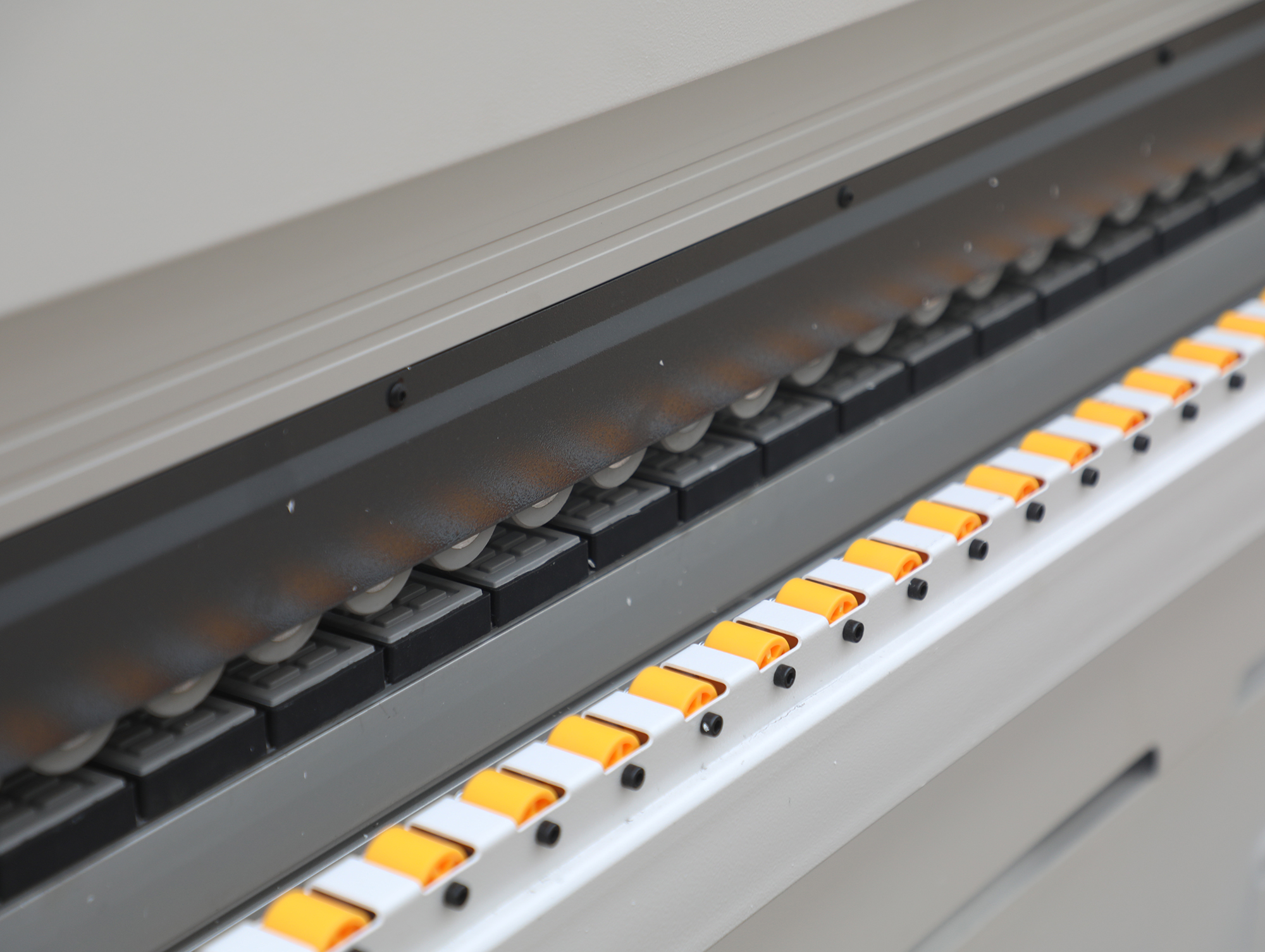
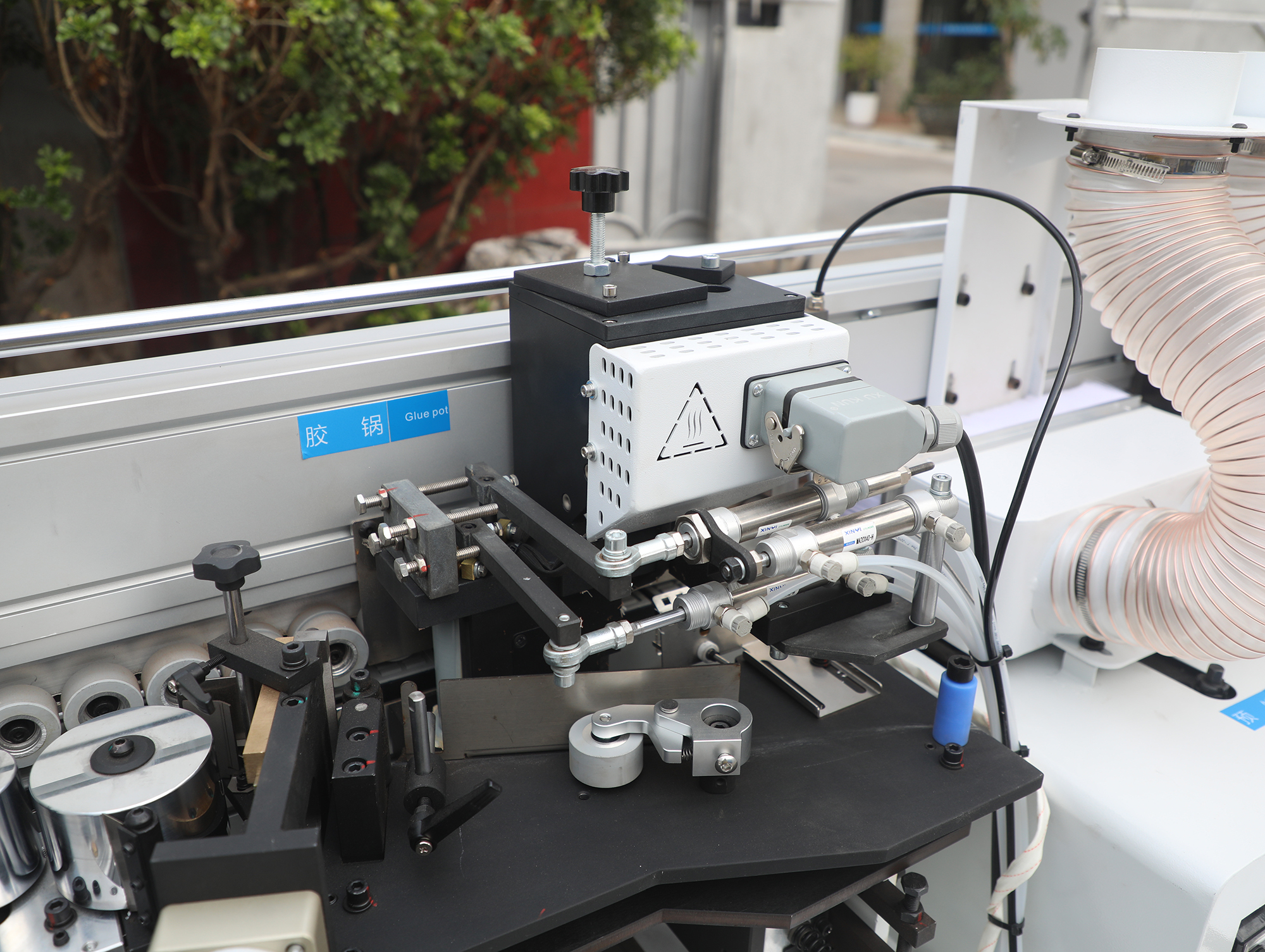
Whichever model a shop installs, the edge result is produced across six stages: feeding, gluing, milling, pressing, trimming and equipment maintenance. Feeding is the most common source of error, and it is controlled mechanically:
- The side ruler / side board is adjusted parallel to the conveyor belt with a straightness of ≤0.1 mm/m, without looseness or deformation; the panel must sit tightly against the fence with no gap or curled edge.
- Feeding roller pressure is set uniformly and matched to panel thickness — lower pressure for thin panels, higher for thick panels — so the panel does not float or deviate. Panel deviation translates directly into uneven edge width.
- Worn conveyor belts or peeled rubber blocks are replaced immediately, and belt height is kept consistent on both sides to avoid tilting the panel.
Incoming panel quality matters too: the cutting process has to be controlled before the panel reaches the edge banding machine, because an out-of-square or chipped panel will appear later as a visible edge defect that no machine setting can remove.
Step-by-Step: How to Run This Comparison in Your Own Shop
Step 1 — Measure the placement before you compare the specifications. Draw the actual bay. The HK268G requires 3790 × 730 × 1210 mm; the HK868P requires 9500 × 1000 × 1650 mm. Add handling space for panel infeed and outfeed, and check door widths, forklift routes and available compressed air lines before either machine is quoted into a layout.
Step 2 — Fix your panel and band mix first. Both machines run 10–60 mm band width and 0.35–3 mm band thickness, so band range will not eliminate either model. Use this step for the other material questions: do you need SS304 surfaces for a humid or coastal workshop, and does daily production actually use the edges of the band range?
Step 3 — Match the machine body to the volume profile. Ask how many panels per shift and how many changeovers per day. Both machines feed at 16–22 m/min; the practical output difference comes from handling, changeover frequency and whether the machine runs continuously or in short batches.
Step 4 — Verify installation conditions. Both machines require 380V 50Hz and 0.7–0.9 Mpa pneumatic power. The HK868P additionally requires a floor loading and levelness plan for a 4T machine. The HK268G’s compact footprint keeps layout changes and relocation feasible later.
Step 5 — Agree the acceptance and quality plan before shipping. Document banding test panels, acceptance criteria and the pre-shipment test procedure, so the machine is verified against your own panel and band materials rather than against a generic sample.
Step 6 — Plan the next machine, not only this one. An edge bander is never a line by itself. If the HK268G is your entry machine, the upgrade path runs toward automatic production lines with a CNC nesting production line, computer panel saw and six side drilling machine. If the HK868P is the anchor, the layout should reserve space and material flow for those stations from the beginning.
Use Cases: Which Machine Fits Which Shop
1. Small-batch custom panel furniture shops. Frequent changeovers, mixed panel sizes and short runs are handled with the flexibility of a compact edge banding machine, and the HK268G can be repositioned as the workshop layout evolves.
2. Shops with limited floor area or shared buildings. Where a 9.5 m bay is simply not available, the HK268G’s 730 mm width and 3790 mm length allow panel edging to run inside a narrow footprint without rebuilding the building.
3. Humid, coastal or high-cleaning environments. Buyers who prioritize corrosion resistance on exposed surfaces can specify the HK268G in carbon steel / SS304, which suits workshops where humidity, glue vapor and frequent cleaning are part of daily operation.
4. Mid-to-large panel furniture production with continuous edging demand. Here the HK868P is installed as the edging cell anchor: 9500 × 1000 × 1650 mm, carbon steel, 4T net weight, planned as a fixed line asset.
5. Line builders and integrators. When a project combines a CNC nesting production line, computer panel saw, automatic edge banding machine and six side drilling machine, the automatic edge bander sets the pace of the cell and should be positioned first in the layout plan.
6. Distributors, importers and OEM partners building a long-term range. SYUTECH is a Foshan-based woodworking machine manufacturer founded in 2013, exporting about 80% of output to Russia, the Middle East, South America, Europe and Southeast Asia. For channel partners, the relevant ecosystem facts are commercial rather than cosmetic: a minimum order quantity of 1 set, a typical production lead time of 30–45 days, and a monthly production capacity of 100 sets, supported by a documented EU reference — an edge banding workshop project in Greece running 10 units in stable operation for 3 years, with a significant increase in output.
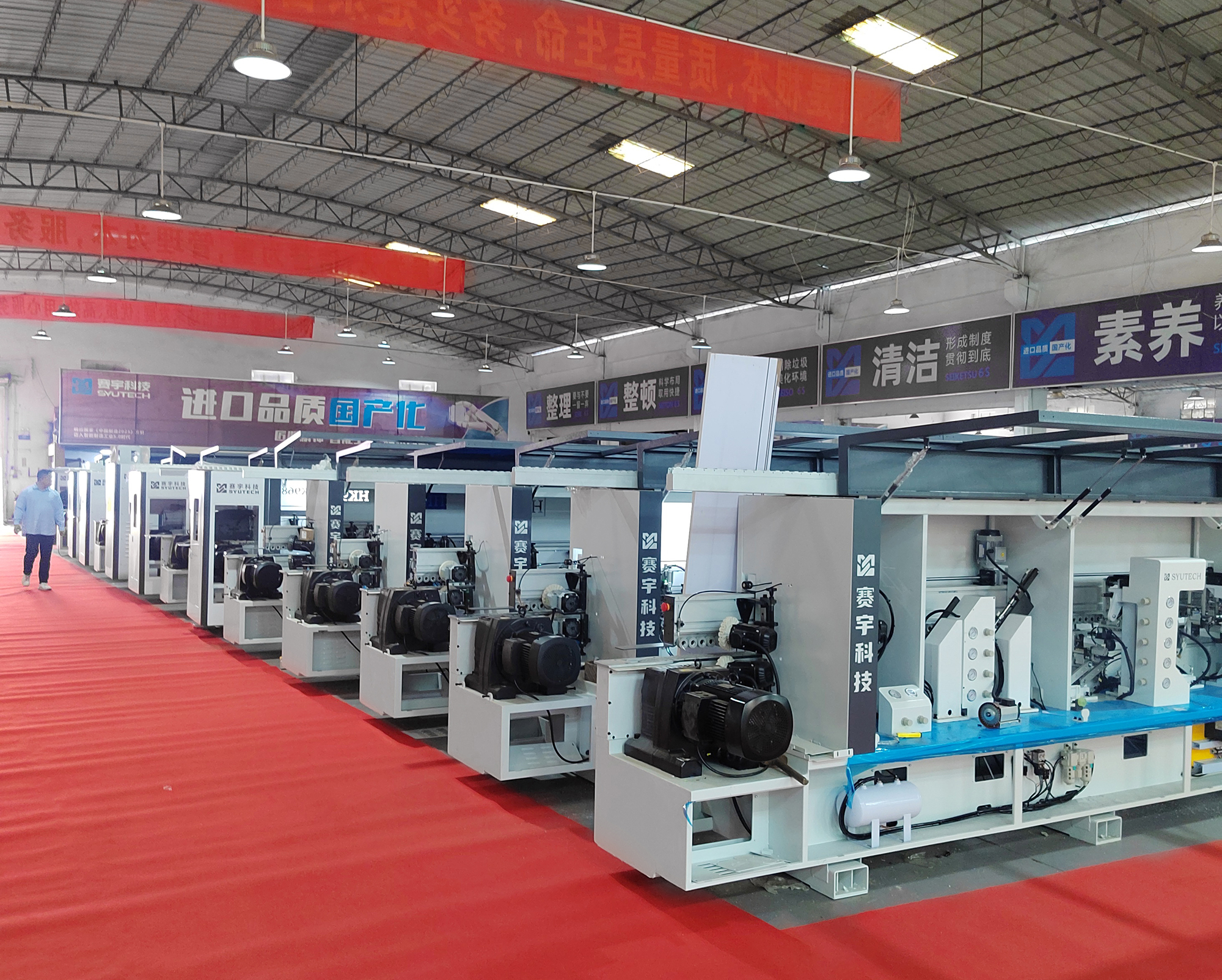
Specification Table: HK268G vs HK868P
| Parameter | HK268G mini edge banding machine | HK868P automatic edge banding machine |
|---|---|---|
| Machine class | Mini / compact edge banding machine | Automatic edge banding machine |
| Overall dimensions (L × W × H) | 3790 × 730 × 1210 mm | 9500 × 1000 × 1650 mm |
| Main construction material | Carbon steel / SS304 | Carbon steel |
| Net weight | Not specified in the available documentation for this comparison | 4T |
| Power supply | 380V 50Hz | 380V 50Hz |
| Edge band width | 10–60 mm | 10–60 mm |
| Edge band thickness | 0.35–3 mm | 0.35–3 mm |
| Feeding speed | 16–22 m/min | 16–22 m/min |
| Pneumatic power | 0.7–0.9 Mpa | 0.7–0.9 Mpa |
| Installation profile | Compact, relocatable unit | Fixed asset; floor loading and levelness planning required |
| Typical role in a shop | Flexible edging cell for small-batch, changeover-driven work | Anchor machine for continuous edging and line integration |
Selection matrix: small-batch flexibility vs automatic production
| Decision criterion | Choose HK268G | Choose HK868P |
|---|---|---|
| Shop footprint | Narrow bay, shared building, restricted access | Dedicated bay with a planned foundation position |
| Batch profile | Frequent small batches and model changeovers | Longer runs with predictable panel flow |
| Volume | Intermittent or mixed production | Continuous daily edging demand |
| Material environment | SS304 surfaces required for humid, coastal or high-cleaning workshops | Carbon steel construction, installed in a controlled bay |
| Mobility | Machine may need to be relocated as the layout changes | Machine is installed as a fixed asset |
| Line integration | Standalone cell or secondary edging station | Anchor of an automatic production line with CNC nesting line, computer panel saw and six side drilling machine |
| Upgrade path | Entry machine that leads to a future automatic line | Line capacity planned around it from day one |
FAQ: HK268G vs HK868P Decisions Buyers Ask About
Do the HK268G and HK868P meet EU edge banding safety requirements?
Edge banding machines fed by chain(s) must comply with the EN 1218-4 safety standard in the European market. This is a machine-level requirement that applies to the configuration and documentation of the exact unit being specified, so buyers should request the compliance documentation for their configuration and confirm it during the pre-shipment acceptance process. SYUTECH exports to Europe alongside Russia, the Middle East, South America and Southeast Asia, so EU-bound orders should be specified with EN 1218-4 in view from the start rather than checked after delivery.
What can the HK868P do that the HK268G cannot, if the banding specifications are the same?
On banding parameters the two machines are specified identically: 10–60 mm edge band width, 0.35–3 mm band thickness, 16–22 m/min feeding speed and 0.7–0.9 Mpa pneumatic power at 380V 50Hz. The difference is the machine body and how it is used. The HK868P measures 9500 × 1000 × 1650 mm with a 4T net weight and is installed as a fixed automatic production asset; the HK268G measures 3790 × 730 × 1210 mm in carbon steel / SS304 and is built to be positioned — and repositioned — in a compact workshop. The capability difference is therefore measured in layout, installation and volume handling, not in band sizes.
What drives the total cost difference between a mini and an automatic edge banding machine?
Total cost is driven by frame construction, stability, consumables, maintenance and after-sales support, not by the purchase price line alone. SYUTECH compares its build standard — a ≥10 mm stress-relieved steel plate integrated milling frame with separately machined unit bases and precision milled reference surfaces — against cheap machines built on 3–5 mm sheet and square tube without stress relief, where body deformation after roughly half a year of use produces accuracy deviation. On that comparison basis, SYUTECH positions its build standard at approximately 30% lower total cost than a cheap edge banding machine. A compact machine and an automatic machine should both be evaluated against the same frame and accuracy criteria.
Can I validate a machine before ordering, and what is the minimum order?
The minimum order quantity is 1 unit, with FOB delivery terms, pre-shipment test as the acceptance criterion and TT payment terms. That structure lets a buyer order a single machine, define the banding test criteria on their own panel and band materials, and validate the result through the pre-shipment test before the machine ships. Shops that plan the HK268G first and the HK868P later can apply the same acceptance approach to both machines.
What is the typical production lead time, and how do long-term partners plan capacity?
Typical production lead time is 30 to 45 days, and monthly production capacity is 100 sets, with a minimum order quantity of 1 set. For distributors, importers and OEM partners, that combination makes a rolling order schedule practical rather than a one-off purchase: capacity exists to absorb repeat orders, and the 30–45 day window can be matched to installation and commissioning schedules at the customer’s site. To plan a small-batch edging cell or a full automatic line, download the SYUTECH factory promotional brochure or send your panel mix, band materials and target output for a machine recommendation.
Conclusion: Flexibility or Automatic Production — Choose the Constraint First
The HK268G and the HK868P are not a good machine and a better machine. They are two answers to two different constraints. When floor space, relocatability, humid-environment material choice and small-batch changeovers dominate, the 3790 × 730 × 1210 mm HK268G in carbon steel / SS304 is the correct investment. When continuous volume, a fixed installation and integration with a nesting CNC line, computer panel saw and six side drilling machine dominate, the 9500 × 1000 × 1650 mm, 4T HK868P is the correct anchor.
Both machines band 10–60 mm wide edge band at 0.35–3 mm thickness, feed at 16–22 m/min and run on 380V 50Hz with 0.7–0.9 Mpa pneumatic power — so the decision should be made on footprint, material environment and volume, then confirmed through factory build quality and a pre-shipment acceptance test on your own panels.
Next step for buyers and channel partners. SYUTECH (Foshan Shunde SaiYu Technology Co., Ltd.) builds edge banding machines, CNC nesting machines, six side CNC drilling machines, computer panel saws and complete panel furniture production line equipment at its 10,000 m² facility in Shunde District, Foshan City, Guangdong Province, China. Founded in 2013, the company employs around 100 people, produces 500 units annually with a monthly capacity of 100 sets, and exports about 80% of its output.
Tell us your panel mix, band materials, batch profile and available floor space, and we will tell you whether the HK268G, the HK868P, or a staged combination fits your production plan — including MOQ 1 set, FOB terms, pre-shipment test acceptance, TT payment and a 30–45 day lead time.
Contact: Debbie / Vanessa — Email: vanessa293199@139.com | Tel / WhatsApp: +86 13929919431 | Address: No. 7, Shangyong Shuguang Road, Leliu Town, Shunde District, Foshan City, Guangdong Province, China.
Website: www.syutech.com | Brochure: Factory promotional paper (PDF)
Have Questions or Need More Details?
Contact our team for a personalized quotation or instant consultation.
Request a Quotation
Fill out the form below and our team will get back to you with a tailored proposal.
WhatsApp Direct Chat
Prefer to chat in real-time? Message us on WhatsApp for instant assistance & quick answers.
- Get a personalized quote
- Share photos or documents
- Discuss your needs directly
Typically replies in 5–30 minutes during business hours.