
Edge Banding Machine After-Sales FAQ: Long-Term Partnership Lessons from Greece and Kenya
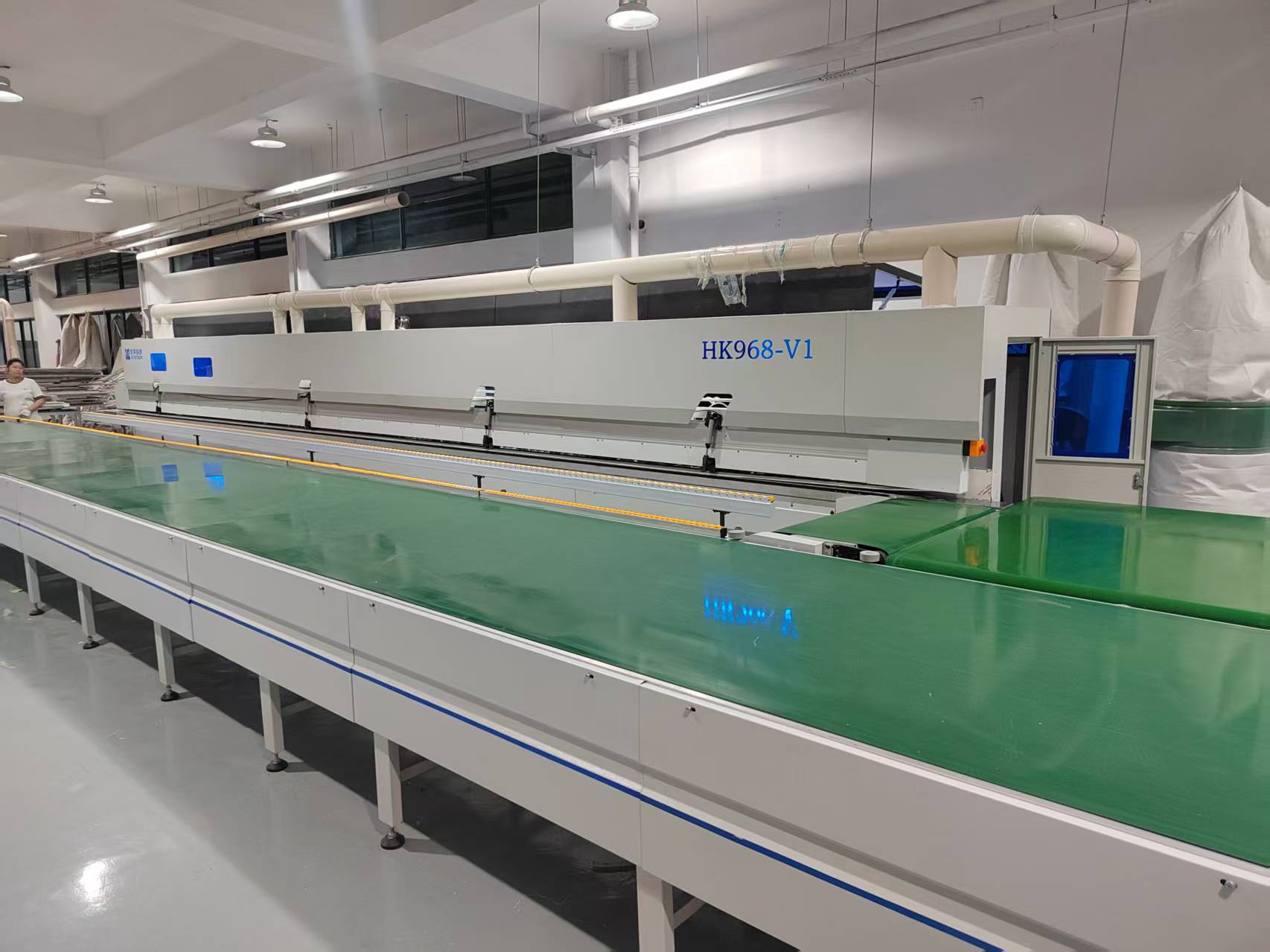
After-sales support for an edge banding machine is not a warranty clause bolted onto a quotation. It is the set of technical and commercial conditions that decide whether an industrial edge banding machine still holds edge quality, cycle time and operator safety in year three — after the installation crew has left and the machine has become part of the production plan.
Two documented projects show what that means in practice. In Greece, a panel furniture manufacturer has operated 10 units in an edge banding workshop for 3 years, in stable operation, with output increased significantly. In Kenya, a panel furniture manufacturer has run 3 units across an edge banding workshop and a CNC router workshop for 2 years, achieving stable edge banding performance, significantly improved edge banding quality and increased output.
This FAQ collects the questions buyers actually ask during supplier evaluation — about supporting equipment, operating conditions, safety requirements, and what stable operation is supposed to mean once a machine is no longer new. Each answer is tied to documented project evidence or published standards rather than to a sales claim.
The Real Question Behind Every Edge Banding Machine After-Sales FAQ
Almost every after-sales question reduces to one underlying question: what will this machine be doing in three years, and who is responsible when it is not doing it?
At the evaluation stage, buyers compare a furniture edge banding machine on visible parameters — feeding speed, edge band thickness range, automation level, and price. The problems that actually interrupt a panel furniture workshop appear later and usually originate outside the machine head: dust and chips that are not captured, unstable power, glue and edge tape that change between batches, trimming tools that are run past their working life, operators who were trained once and never refreshed, and a supplier who cannot name the part that failed.
That is why an after-sales evaluation is not a soft topic. It is a specification exercise, and it has to be done before the purchase order, not after the first quality complaint.
Short answer: judge a supplier's after-sales capability by three verifiable signals — multi-year operating references in comparable workshops, a defined compliance route for your market, and a documented plan for supporting equipment and consumables. The Greek and Kenyan projects below are exactly that kind of signal.
Industry Background: Why After-Sales Has Become a Buying Criterion
Two trends have pushed after-sales from a footnote into the shortlist criteria.
First, the installed base keeps growing. Market Research Future estimates the global automatic edge banding machine market at USD 3.658 billion in 2024, with a projected CAGR of 4.56% over 2025–2035. A larger installed base means more machines reaching the age where service history matters more than brochure features. Industry analysis cited by EIN Presswire indicates that Chinese manufacturers account for approximately 40% of global edge banding machine shipments, which is why supplier evaluation increasingly means comparing Chinese manufacturers on documentation and service depth rather than on availability alone.
Second, compliance has become part of the service conversation. For EU delivery, the relevant electrical safety route for machinery such as the SYUTECH HK series is CE certification against EN 60204-1:2018 and EN ISO 12100:2010. Alongside this, machine-type safety standards define the hazards a buyer should expect the supplier to have designed out: ISO 18217:2015 deals with significant hazards relevant to edge banding machines fed by chains with manual loading and unloading and a maximum work-piece height capacity of 100 mm, while EN ISO 19085-17:2021 addresses safety for chain-fed edge-banding machines. A supplier that cannot explain which standard applies to the exact configuration being quoted will also struggle to support that configuration in year two.
Both trends point the same way: the machine is a long-lived asset, and the purchase decision is really a decision about who maintains its output over time.
What a Long-Term Edge Banding Machine Partnership Includes at SYUTECH
SYUTECH (Foshan Shunde Saiyu Technology Co., Ltd.) is a woodworking machinery manufacturer based in Shunde District, Foshan, Guangdong, China, originally established in 2013 as Foshan Shunde Leliu Huake Long Precision Machinery Factory and operating today under the Saiyu Technology brand. The company runs a 10,000 m² facility with annual output of 500 units and approximately 80% of sales going to export markets including Russia, the Middle East, South America, Europe and Southeast Asia.
For after-sales purposes, three structural facts matter more than any single machine specification.
1. A portfolio that covers the supporting equipment
SYUTECH supplies fully automatic edge banding machines, laser edge banding machines, CNC six-sided drilling machines, computer panel saws, and complete panel furniture equipment and automated production lines. In practice this means a buyer can settle the interface questions — extraction, infeed and outfeed, workshop layout, downstream drilling — with one technical contact instead of coordinating several vendors when something drifts.
2. A defined CE route for EU-bound machines
SYUTECH machinery in the HK series is CE certified for the EU market under certificate HTT202405661L, with the electrical and risk-assessment basis stated as EN 60204-1:2018 and EN ISO 12100:2010. For a buyer in Europe, that is a starting point for a service conversation, not an ending point: the same documentation should be able to tell you which configuration was assessed and what changes would require re-assessment.
3. An after-sales service team inside the company structure
The company describes its core strengths as skilled technical personnel, machining equipment, testing instruments, production management experience, and a well-established after-sales service team. That statement is only worth something if it survives contact with real projects — which is what the Greek and Kenyan references are used for in this article.
Step-by-Step: How to Evaluate After-Sales Before You Sign
The sequence below is written for the evaluation stage of a purchase, when the shortlist is still open. It works for an automatic edge banding machine, a semi automatic edge banding machine, or a manual edge banding machine, because the questions are about the working environment rather than the automation level.
- Write down the conditions you will actually run. Indoor, dust-contained workshops are the normal operating condition for panel furniture production, and dust containment is a maintenance issue as much as a health issue. Record board types (MDF, particleboard, plywood, block board, PVC and similar), shift pattern, edge tape thickness range and the number of changeovers per shift.
- Fix the compliance route for your market. Ask which certificate applies to the exact model and which standards it was assessed against. For EU delivery of the SYUTECH HK series, that is CE certificate HTT202405661L with EN 60204-1:2018 and EN ISO 12100:2010. Confirm whether the configuration you are ordering falls within the scope of the relevant machine-type standard, such as ISO 18217:2015 or EN ISO 19085-17:2021.
- Match the machine to the panel mix, not to the brochure headline. Using the HK868 as an example, the published figures are a minimum panel width of 40 mm, edge band width of 10–60 mm, edge band thickness of 0.4–3 mm, and feeding speed of 18–22–25 m/min. A compact automatic edge bander in the same family is listed with 7 functions and a feeding speed of 18–23 m/min. If your narrowest panel or your thickest tape sits outside these ranges, the service discussion is already academic.
- Map the supporting equipment before delivery. Extraction capacity, compressed air, power supply stability, infeed and outfeed space and workshop layout should be agreed in writing. Most “machine problems” reported in year one are actually supporting-equipment problems.
- Agree an acceptance test with measurable outputs. Define sample panels, edge quality criteria, and the speed range to be demonstrated. The SYUTECH workflow to be verified covers conveying, gluing and welting, cutting, front and rear alignment, upper and lower trimming, upper and lower scraping, and polishing — each stage is a checkpoint, not a single pass/fail.
- Agree the escalation path and the spare parts list. Name the contact, the escalation level, the response-time definition and the wear parts you will keep on site. This is the part of after-sales that buyers most often leave verbal.
- Schedule the review at 12, 24 and 36 months. Ask the supplier for references that have already reached those milestones, and ask the reference what broke and how it was handled. A reference that reports no issues at all is less informative than one that reports a specific failure and a specific fix.
Use Cases: Three Years in Greece and Two Years in Kenya
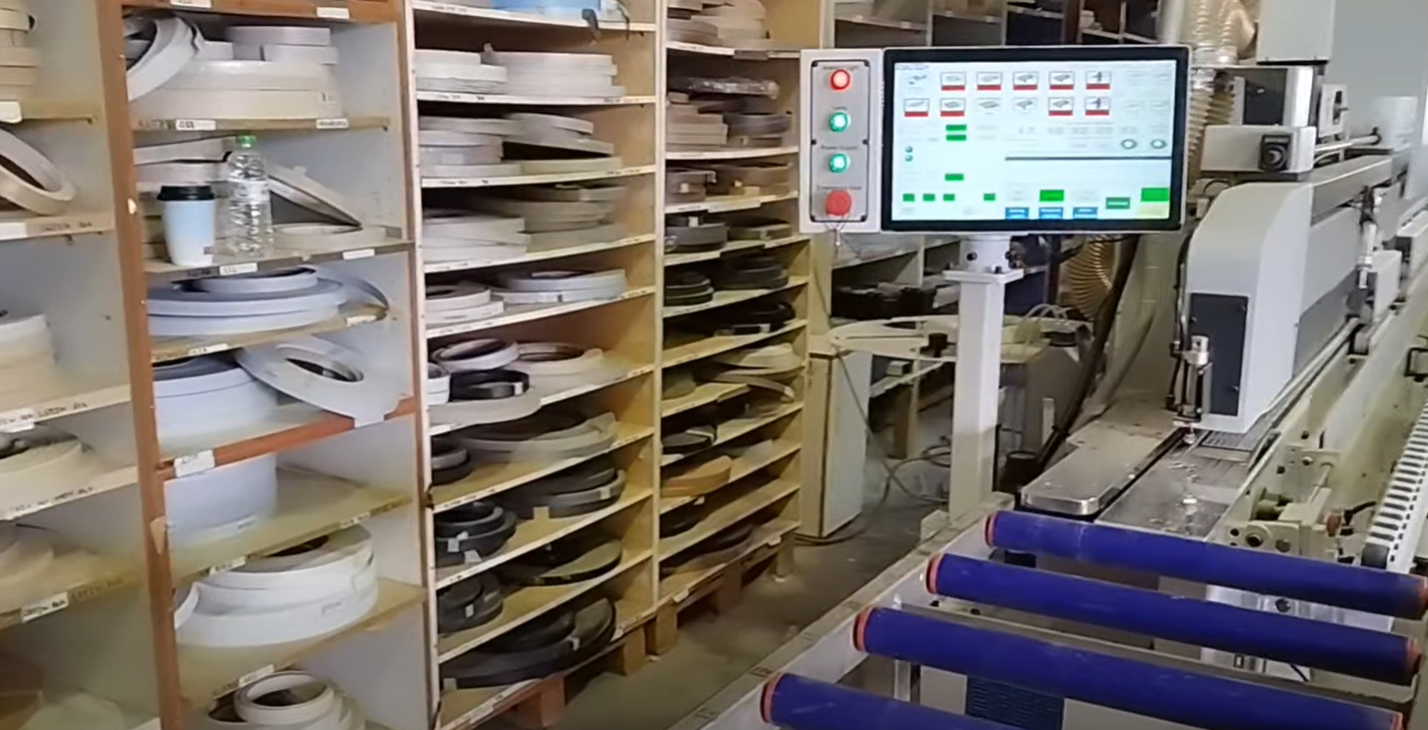
Greece — 10 units, 3 years, one edge banding workshop
A panel furniture manufacturer in Greece has been using the equipment in an edge banding workshop since the project was installed. The reference covers 10 units and 3 years of stable operation, with the documented result that output increased significantly. The models recorded in this project are the Edge Banding Machine HK568 and the Automatic Edge Banding Machine HK868P.
For an evaluator, the useful part is not the unit count on its own. It is that ten machines installed in one workshop have to be supported as a fleet: consistent setup across units, one consumables standard, shared operator practice, and a maintenance routine that does not depend on which machine happens to be running. Three years of stable operation under that arrangement is a stronger signal than a single-machine demonstration.
The Greek project also sits in an EU market, which is why the CE route matters here: the HK series is certified under CE certificate HTT202405661L against EN 60204-1:2018 and EN ISO 12100:2010. Long-term operation in that context assumes the machine was placed on the market with the documentation the market requires.
Kenya — 3 units, 2 years, two connected workshops
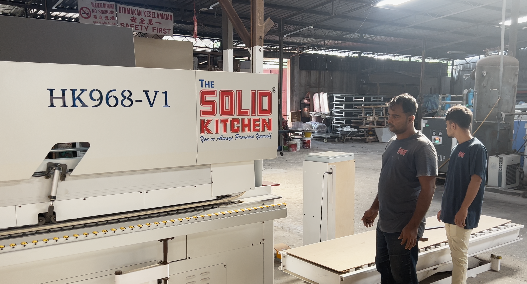
A panel furniture manufacturer in Kenya has deployed the equipment across an edge banding workshop and a CNC router workshop. The project has been in operation for 2 years. Documented results are stable edge banding performance, significantly improved edge banding quality, and increased output. The reference lists the Edge Banding Machine HK568 and the Automatic Edge Banding Machine HK868P alongside CNC equipment from the same supplier.
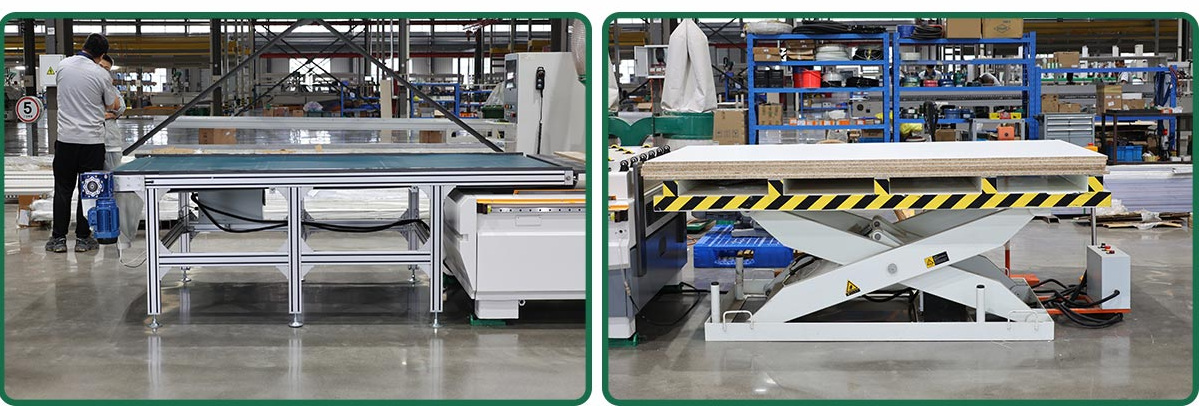
This case answers a different after-sales question: what happens when the edge banding machine shares a workshop floor with other processes. Dust and chip load, power quality and shift scheduling are shared across both workshops, so an improvement in edge banding quality over two years implies the surrounding conditions were managed, not just the machine head.
Comparison Table: Matching After-Sales Questions to Documented Evidence
The table below pairs the questions buyers raise at the evaluation stage with the evidence that answers them. Every entry is drawn from the project records or published standards cited in this article.
| Evaluation question | What to verify | Documented answer |
|---|---|---|
| Will the machine still be running in year three? | Multi-year reference in a comparable workshop | Greece: 10 units, 3 years, stable operation. Kenya: 3 units, 2 years, stable edge banding performance. |
| Does throughput hold up after commissioning? | Output trend reported by the user | Greece: output increased significantly. Kenya: output increased. |
| Is edge quality stable, not just good on day one? | Edge quality outcome over time | Kenya: edge banding quality has improved significantly over 2 years. |
| Can it be placed on an EU production site? | CE conformity and assessed standards | SYUTECH HK series CE certificate HTT202405661L; EN 60204-1:2018 and EN ISO 12100:2010. |
| Does the specification fit the actual panel mix? | Published operating range | HK868: minimum panel width 40 mm; edge band width 10–60 mm; edge band thickness 0.4–3 mm; feeding speed 18–22–25 m/min. Compact model: 7 functions, 18–23 m/min. |
| Can one supplier cover the surrounding equipment? | Product portfolio breadth | Fully automatic edge banding machines, laser edge banding machines, CNC six-sided drilling machines, computer panel saws, complete panel furniture equipment and automated production lines. |
| Which safety scope applies to the machine type? | Machine-type standards | ISO 18217:2015 covers chain-fed edge banding machines with manual loading and unloading and maximum work-piece height capacity of 100 mm; EN ISO 19085-17:2021 addresses safety for chain-fed edge-banding machines. |
Frequently Asked Questions
Q1. Which safety standards should an edge banding machine meet for the EU market?
For the EU market, the electrical and risk-assessment basis for SYUTECH HK series machinery is CE certification against EN 60204-1:2018 and EN ISO 12100:2010, held under CE certificate HTT202405661L. Separately, machine-type safety standards define the hazards a buyer should expect to be addressed: ISO 18217:2015 applies to edge banding machines fed by chains with manual loading and unloading and a maximum work-piece height capacity of 100 mm, and EN ISO 19085-17:2021 covers safety for chain-fed edge-banding machines. Buyers should confirm that the exact configuration ordered falls within the scope of the applicable standard, and should note that a certificate covers a defined configuration rather than every possible option.
Q2. What supporting equipment and operating conditions keep an industrial edge banding machine stable over several years?
Panel furniture workshops typically operate indoors in dust-contained conditions, and stability over multiple years depends on managing that environment as much as on the machine itself: effective chip and dust extraction at the cutting and trimming points, stable power supply, clean compressed air where the machine uses it, and operators who are trained on setup and changeover rather than only on start and stop. The Greek reference — 10 units in one edge banding workshop, stable operation for 3 years — and the Kenyan reference — 3 units across an edge banding and CNC router workshop, 2 years with improved edge banding quality — both describe workshops where these conditions were maintained in parallel with the machines.
Q3. Which costs appear after installation rather than at the point of purchase?
The recurring cost of an edge banding machine is driven by consumables and workshop support, not by the machine frame: edge tape and adhesive consumption that shift with the board mix (MDF, block board, solid wood board, particleboard, polymer door plates, plywood, PVC board and similar), trimming and scraping tooling that wears with throughput, extraction and workshop air, operator training when staff change, and lost output during unplanned stops. Because published pricing for these items is not fixed across markets and configurations, the practical approach is to request an itemised quotation that separates machine, tooling, consumables start-up stock and service items, then compare the three-year total rather than the invoice total.
Q4. How can a buyer validate a furniture edge banding machine before placing a multi-unit order?
Validation has three layers. First, a specification check against your own panel mix — for reference, the HK868 is published with a minimum panel width of 40 mm, edge band width of 10–60 mm, edge band thickness of 0.4–3 mm and feeding speed of 18–22–25 m/min; a compact automatic model in the same family is listed with 7 functions and 18–23 m/min. Second, a run on your own boards covering the full workflow the machine performs: conveying, gluing and welting, cutting, front and rear alignment, upper and lower trimming, upper and lower scraping, and polishing. Third, reference verification — speak to projects that have already passed the 24- and 36-month marks, such as the Greek 10-unit installation at 3 years and the Kenyan 3-unit installation at 2 years, and ask what failed and how quickly it was resolved.
Q5. What should a long-term supply agreement include for a woodworking edge banding machine?
A long-term agreement should name the wear-parts list and the parts you will keep on site, define the escalation contact and response-time expectation, confirm who provides refresher training when operators change, and set an annual review that compares actual edge quality and output against the commissioning baseline. For multi-unit workshops, it should also state that setup parameters are standardised across units so that one machine is not running to a different routine than the rest — the condition that made the Greek 10-unit workshop manageable. SYUTECH publishes its full machine range and factory profile at syutech.com, and buyers preparing an evaluation can download the factory brochure below or send their workshop conditions directly for a configuration review.
Next step for evaluation-stage buyers: send your board mix, edge tape thickness range, shift pattern and workshop layout to the SYUTECH team, and request a configuration review against the HK568 / HK868P range plus the supporting equipment list. The factory brochure gives the portfolio overview needed for that conversation.
Email: zywoodmachine@163.com / vanessa293199@139.com | Tel / WhatsApp: +86 15019677504 / +86 13929919431
Conclusion: After-Sales Is a Specification, Not a Promise
The Greek and Kenyan projects answer the after-sales question in a way that a brochure cannot. In Greece, 10 units have run in a single edge banding workshop for 3 years with stable operation and significantly increased output. In Kenya, 3 units have run for 2 years across an edge banding workshop and a CNC router workshop, with stable edge banding performance, significantly improved edge banding quality and increased output.
What those projects demonstrate is not that machines never fail. It is that long-term output depends on four things being settled before delivery: the machine specification matching the panel mix, the compliance route being correct for the destination market, the supporting equipment and dust-contained workshop conditions being planned rather than improvised, and a named service path for parts, training and escalation.
For buyers evaluating an industrial edge banding machine today, that is the practical test to apply to every supplier on the shortlist: ask for multi-year references in a comparable workshop, ask which standards the exact configuration was assessed against, and ask what the service plan looks like in year three — not just on the day of commissioning.
Have Questions or Need More Details?
Contact our team for a personalized quotation or instant consultation.
Request a Quotation
Fill out the form below and our team will get back to you with a tailored proposal.
WhatsApp Direct Chat
Prefer to chat in real-time? Message us on WhatsApp for instant assistance & quick answers.
- Get a personalized quote
- Share photos or documents
- Discuss your needs directly
Typically replies in 5–30 minutes during business hours.