
Setting Up an Edge Banding + CNC Drilling Cell: Project Blueprint for Panel Furniture Factories
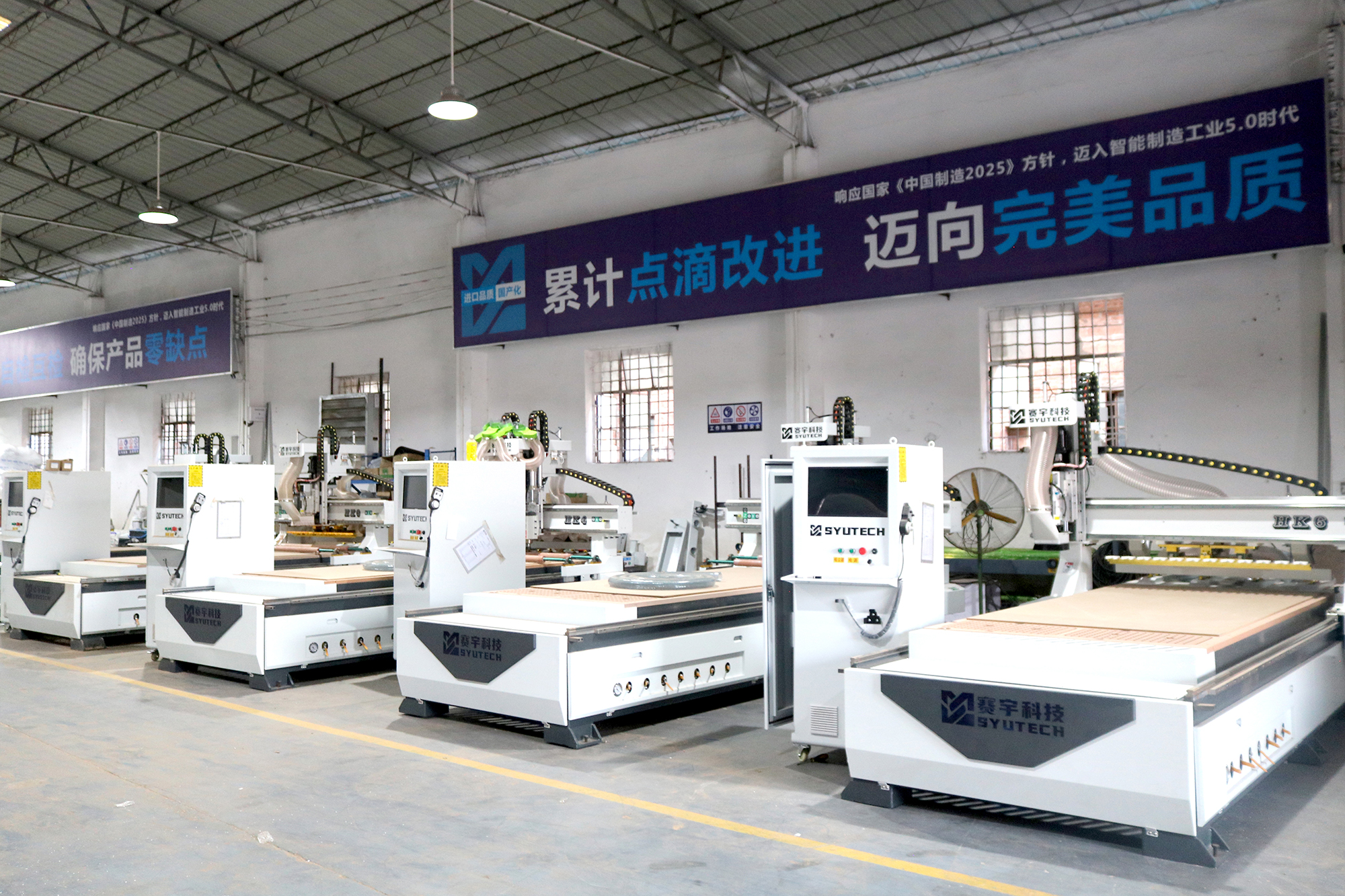
An edge banding + CNC drilling cell is a three-station production cluster in which one edge banding machine, one side drilling machine and one CNC router share a single panel flow, a single compressed-air supply and a single dust-extraction path. For a panel furniture factory it is the smallest configuration that still delivers a finished cabinet side panel with a glued, trimmed and polished edge plus a complete set of dowel and hardware holes.
This project blueprint describes how to set that cell up on a real factory floor: what each station does, how the floor plan is organised, what panel envelope every machine has to cover, which auxiliary equipment is easy to forget (air compressor, vacuum cleaner, vacuum pump), what working environment the cell assumes, and how compliance is verified before the order rather than during installation. It also shows the configuration in operation. SYUTECH's documented panel furniture edge banding application in Kenya runs in continuous automatic cycle operation with manual feeding assistance, and the equivalent application in Romania produces cabinets and cabinet doors under the same indoor, dust-contained working conditions.
The Problem: Most Panel Furniture Cells Fail at Specification, Not at the Machine
Three well-chosen machines can still produce a cell that does not flow. In practice the failures cluster around four assumptions that are made before any purchase order is issued.
Assumption 1: the panel envelope is already known
Cells are usually planned around the largest panel the factory expects to run, while the smallest panel is ignored. The HK612B side drilling machine covers a maximum processing size of 2800 × 1220 mm and a minimum processing size of 140 × 40 mm. Edge banding models in the same class handle a minimum panel width of 40 mm and a minimum panel length of 135 mm to 150 mm depending on the model. Drawer fronts, shelf strips and door rails that fall under those minimums do not pass through the cell as one continuous flow — they become a separate manual workstream, and the cell loses the throughput it was bought for.
Assumption 2: any automatic edge banding machine will do
Manual, semi-automatic and automatic edge banding machines are frequently compared on purchase price instead of on cycle structure. The documented production configuration in the Kenya and Romania applications is a continuous automatic cycle with manual feeding assistance: the operator positions the panel, the machine runs the full edge finishing sequence, and the operator feeds the next panel. That cycle structure — not the machine category label — determines how many panels leave the station per shift.
Assumption 3: the cell needs power and nothing else
Edge banding and drilling stations do not run on electrical supply alone. The documented applications list an air compressor, a vacuum cleaner and, where the configuration requires it, a vacuum pump as matched equipment. Pneumatic demand on SYUTECH edge banding models is 0.7–0.9 MPa, and the electrical supply on the models in this blueprint is 380 V, 50 Hz, three-phase. Utilities that are ordered after the machines are delivered are the most common cause of a delayed start-up.
Assumption 4: compliance is an afterthought
The working condition assumed by the documented applications is an indoor environment at normal temperature and humidity inside a dust-contained wood processing space, meeting EU CE mechanical and low voltage safety standards, with no explosion-proof requirement. That is checkable information before the order. Treating it as a post-installation issue turns a two-week commissioning into a multi-month one.
Industry Background: What Is Changing in Panel Furniture Machinery
The global automatic edge banding machine market was estimated at USD 3.658 billion in 2024, with a projected compound annual growth rate of 4.56% between 2025 and 2035, according to a 2026 report published by Market Research Future.
Supply is concentrated. A 2026 industry analysis published by EIN Presswire estimates that Chinese manufacturers account for approximately 40% of global edge banding machine shipments. The practical consequence for a factory planning a cell is that the edge bander, drilling machine and router are most often sourced from Chinese manufacturers, while the installation, utility and compliance burden stays with the buyer. That shifts the centre of gravity of the project from machine selection to cell specification.
Two published standards define the technical frame. ISO 18217:2015 deals with the significant hazards, hazardous situations and events relevant to edge banding machines fed by chains with manual loading and unloading and a maximum work-piece height capacity of 100 mm. EN ISO 19085-17:2021 covers safety requirements for chain-fed edge banding machines. On the supplier side, SYUTECH machinery is CE certified under certificate HTT202405661L, with EN 60204-1:2018 and EN ISO 12100:2010 applied as standards.
SYUTECH is the brand of Foshan Shunde SaiYu Technology Co., Ltd., a woodworking machinery manufacturer located in Shunde District, Foshan City, Guangdong, China. The company was originally established in 2013 as Foshan Shunde Leliu Huake Long Precision Machinery Factory, operates a 10,000 m² manufacturing facility with approximately 100 staff and a two-engineer R&D team, and reaches an annual production capacity of 500 units. Its product scope covers edge banding machines, CNC nesting machines, six-side CNC drilling machines, computer panel saws and complete panel furniture production lines. Export business accounts for 80% of total sales, with major markets in Russia, the Middle East, South America, Europe and Southeast Asia, and the company introduced technology from Europe through a collaboration with TEKNOMOTOR, an Italian company.
The Cell Blueprint: Three Stations, One Flow
The blueprint is a linear cell with one clean panel path and no cross-traffic. Panels enter at one end, pass through sizing, edge banding and drilling, and leave at the other end into an assembly buffer. Three stations define the cell, and each one has to be specified against the same panel list.
Station 1 — Edge banding: the finishing station
The edge banding machine performs the full edge sequence on the panel: conveying, gluing and welting, end cutting, front and rear alignment, upper and lower trimming, upper and lower scraping, and polishing. SYUTECH describes the machine as the automated alternative to manual edge banding procedures, which is the correct way to read the station’s role inside a cell: it removes the manual edge workflow, it does not remove the operator.
Model selection is driven by panel envelope, band specification and throughput. The automatic HK868P runs at a working speed of 16–22 m/min with a total power of 25 kW at 380 V, 50 Hz, covers edge band widths of 10–60 mm and band thicknesses of 0.4–3 mm, and measures 9500 × 1000 × 1650 mm at approximately 4 t. The HK568 automatic edge banding machine covers the same 10–60 mm band width and 0.4–3 mm thickness range at a feeding speed of 16–18–22 m/min, with an installed power of 25.86 kW, an air pressure requirement of 0.7–0.9 MPa, an overall dimension of 7200 × 710 × 1628 mm and a machine weight of 2200 kg. The compact HK268GY and the mini HK268G extend the range down to a minimum panel width of 40 mm and a minimum panel length of 150 mm, with installed power of 12.4 kW and 11.8 kW respectively at 380 V, 50 Hz, pneumatic demand of 0.7–0.9 MPa, and overall dimensions of 5360 × 730 × 1210 mm and 3790 × 730 × 1210 mm.
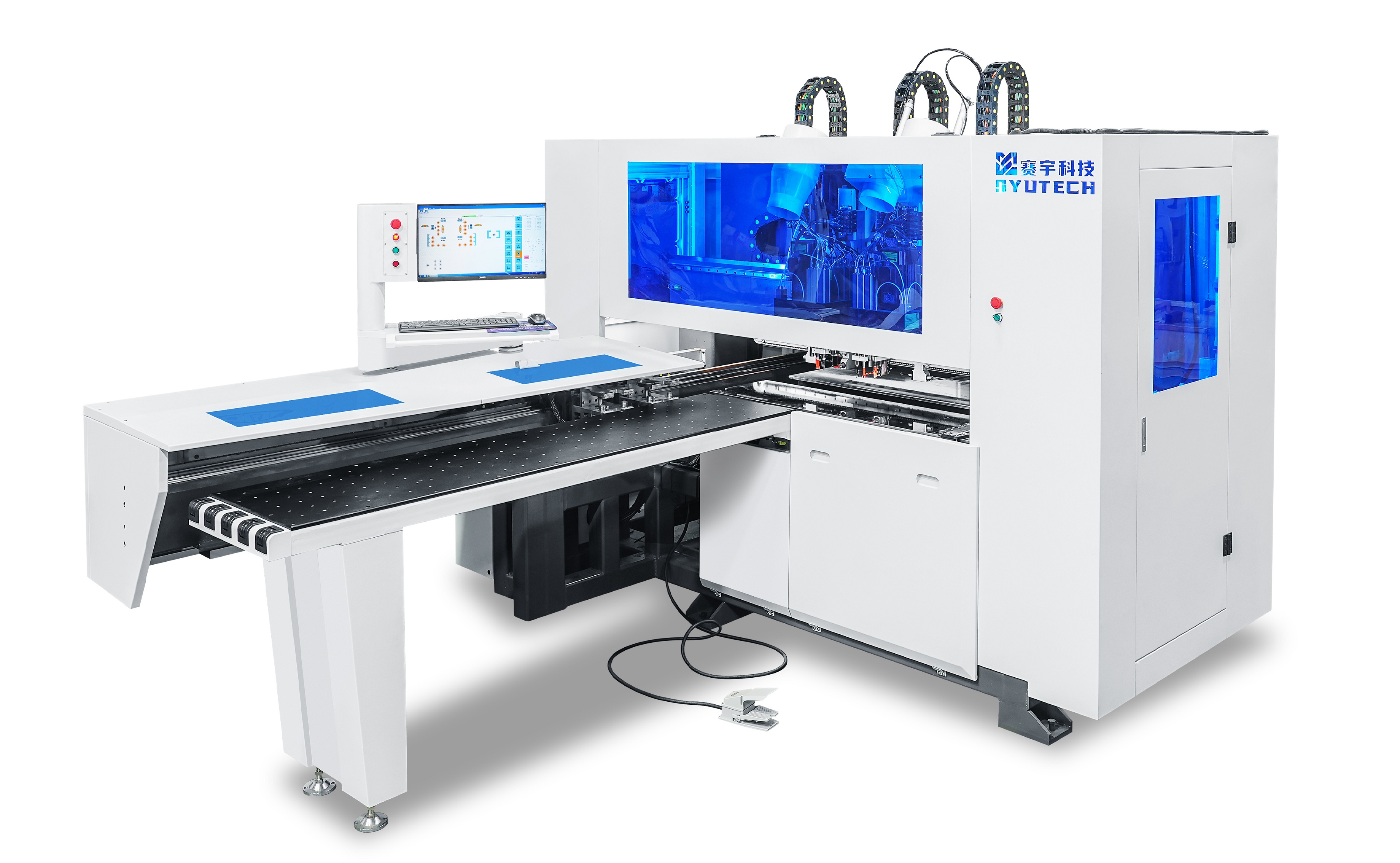
Station 2 — Side drilling with the HK612B
The HK612B is a side drilling machine in the CNC drilling machine category, built for the woodworking machine industry in carbon steel. It handles a maximum processing size of 2800 × 1220 mm and a minimum processing size of 140 × 40 mm, with a working length of 2800 mm on the X-axis, 1220 mm on the Y-axis and 50 mm on the Z-axis. Maximum axis speeds are 120 m/min on X, 80 m/min on Y and 30 m/min on Z.
The tool configuration is what makes this station the drilling anchor of the cell: 10 top vertical drilling tools, 8 horizontal drilling tools on the XY plane, and 9 bottom vertical drilling tools. That combination is what allows vertical and side holes for flat-pack cabinet construction to be produced at a single station instead of across two. The machine measures 5200 × 2900 × 2300 mm and weighs 3500 kg, which is the footprint item most often underestimated in a floor plan.
Station 3 — CNC router: the sizing and cut-out station
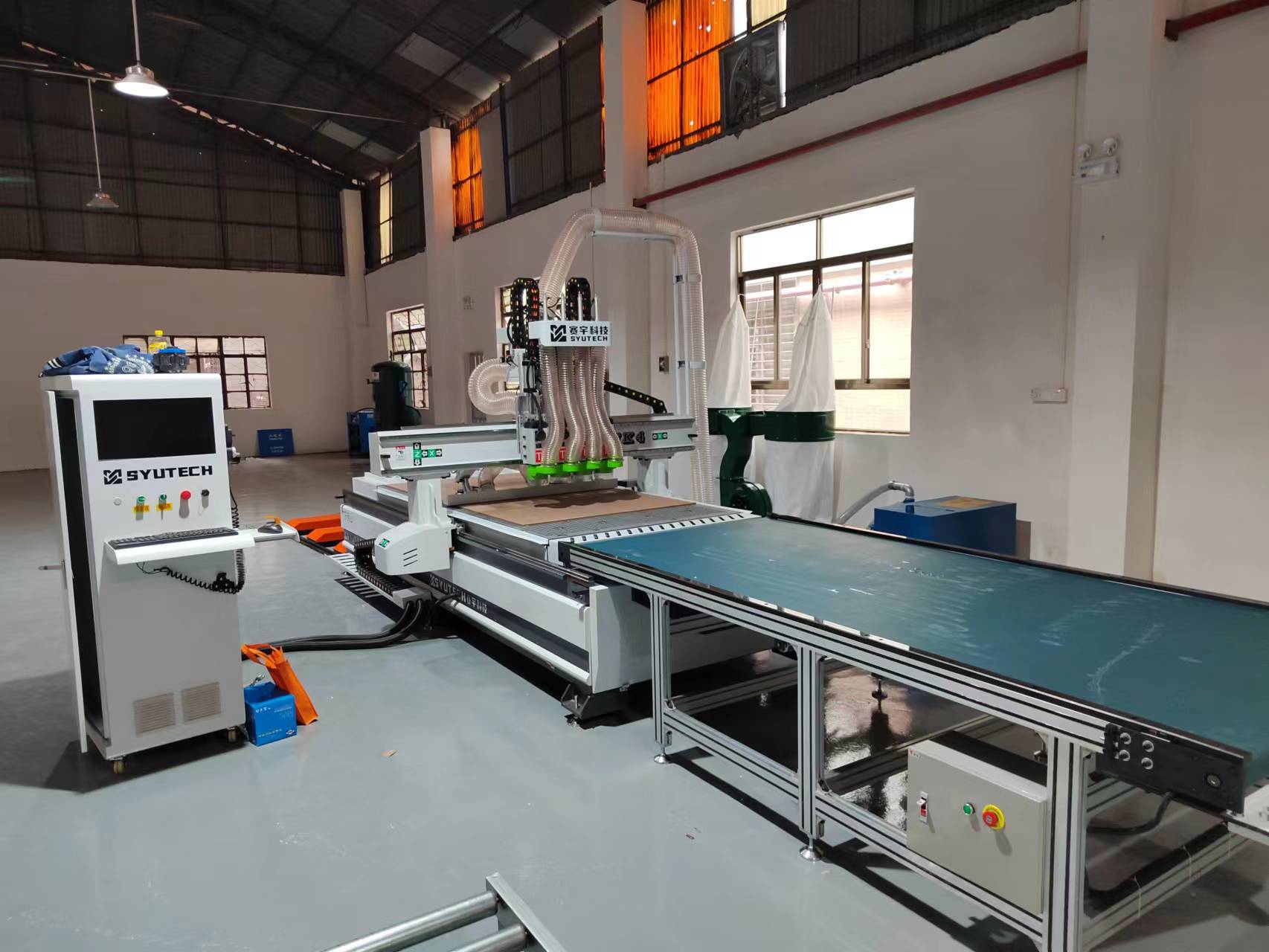
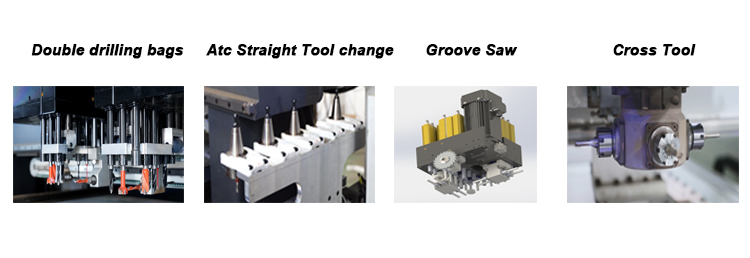
The CNC router handles panel sizing, cut-outs and shaped components upstream of or alongside the other two stations. The HK6 specification used across the SYUTECH nesting range gives a working range of 1220 mm on the X-axis, 2800 mm on the Y-axis and 250 mm on the Z-axis, a 9 kW air-cooled spindle running at 24000 rpm, a 12-tool automatic tool changer of the straight-line type, four 1.5 kW servo motors with matched drivers, an 11 kW frequency converter, and a Taiwanese SYNTEC or LNC control system, on a 380 V, three-phase, 50 Hz supply.
Utilities: air, vacuum and dust
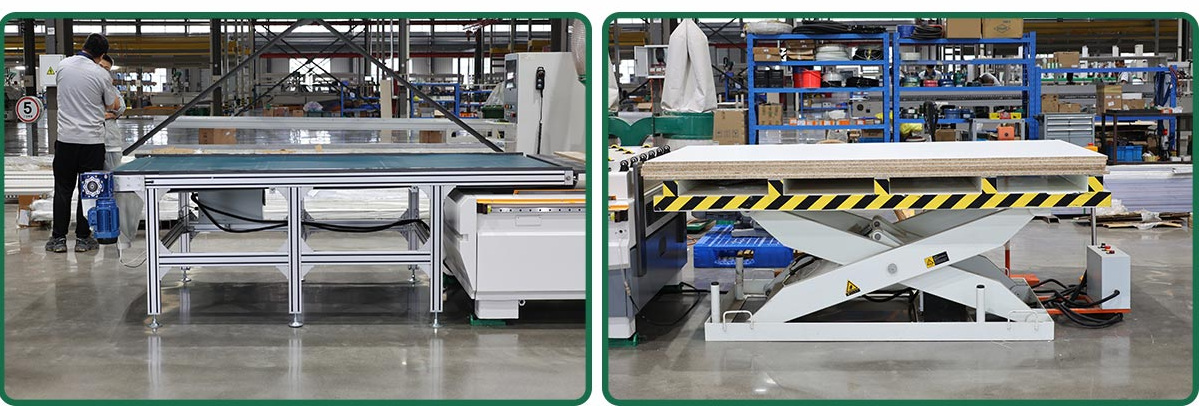
A cell is only as reliable as its auxiliary package. The documented Kenya configuration lists an air compressor and a vacuum cleaner as matched equipment. The documented Romania configuration lists a vacuum cleaner, a vacuum pump and an air compressor. Plan for three utility groups: compressed air at 0.7–0.9 MPa at the edge banding station; an electrical supply at 380 V / 50 Hz three-phase with installed power matched to the selected models, from 11.8 kW on the HK268G to 25.86 kW on the HK568; and extraction sized for a dust-contained wood processing environment rather than for a clean room.
Environment and floor conditions
The assumed operating environment for these applications is indoor, at normal temperature and humidity, inside a dust-contained wood processing space. Neither the Kenya nor the Romania application carries an explosion-proof requirement, and both meet EU CE mechanical and low voltage safety standards. In layout terms that means three things: stable indoor conditions rather than an open shed, physical separation between the dust-generating stations and the control cabinets, and a panel path that keeps the freshly banded panel away from routing and drilling dust.
Step-by-Step: Building the Cell from Decision to Commissioning
- Fix the panel envelope before you fix the machine list. Write down the largest and smallest panel, the band thickness range and the edge band width range you actually run. These are the numbers to check against: maximum processing size 2800 × 1220 mm and minimum processing size 140 × 40 mm on the HK612B; edge band width 10–60 mm with band thickness 0.35–3 mm on the compact and mini edge banding models and 0.4–3 mm on the HK568 and HK868P; minimum panel width 40 mm and minimum panel length 135–150 mm depending on the model.
- Choose the automation level deliberately. Manual, semi-automatic and automatic edge banding machines differ in cycle structure. The documented production configuration in both reference markets is continuous automatic cycle operation with manual feeding assistance, so the decision is really about how many panels the operator can load per hour at the specified 16–22 m/min feeding speed.
- Decide and document the station sequence. Both drilling-then-banding and banding-then-drilling sequences are used in panel furniture production. Either can work; what breaks a cell is running both on the same line without a buffer. Choose one sequence, write it into the process sheet, and place a physical buffer between the edge banding and drilling stations so that one station’s stoppage does not cascade into the other.
- Lay out the floor around real footprints. Edge banding stations run from 3790 × 730 × 1210 mm (HK268G) and 5360 × 730 × 1210 mm (HK268GY) to 7200 × 710 × 1628 mm (HK568) and 9500 × 1000 × 1650 mm (HK868P). The HK612B drilling machine occupies 5200 × 2900 × 2300 mm at 3500 kg, and the HK6 router works a 1220 × 2800 mm table with 250 mm of Z travel. Add infeed and outfeed length for the longest panel you run, plus operator clearance on the loading side.
- Specify the utility package as one order. Compressed air at 0.7–0.9 MPa; 380 V / 50 Hz three-phase supply with installed power matched to the selected models; an air compressor, vacuum cleaner and, where required, a vacuum pump; and extraction designed for a dust-contained environment.
- Set the environment and the housekeeping rule. Indoor normal temperature and humidity, dust contained at the source, and a written rule for keeping banded panels out of the dust zone. No explosion-proof requirement applies to this application class, which keeps both the electrical specification and the cost of the cell predictable.
- Confirm compliance before the order, not after delivery. Verify the CE certificate HTT202405661L and the applied standards EN 60204-1:2018 and EN ISO 12100:2010. Check whether ISO 18217:2015 applies to your bander — it covers chain-fed edge banding machines with manual loading and unloading and a maximum work-piece height capacity of 100 mm — and confirm the EN ISO 19085-17:2021 safety route for chain-fed edge banding machines.
- Commission into a written operating standard. Commission the cell in continuous automatic cycle operation with manual feeding assistance, then record the feeding rhythm per panel size, the band and glue settings per edge type, and the compressed-air reading at the start of every shift. The commissioning record is what keeps the cell running at specification after month three.
Use Cases: How the Blueprint Looks in Real Projects
Kenya: panel furniture edge banding
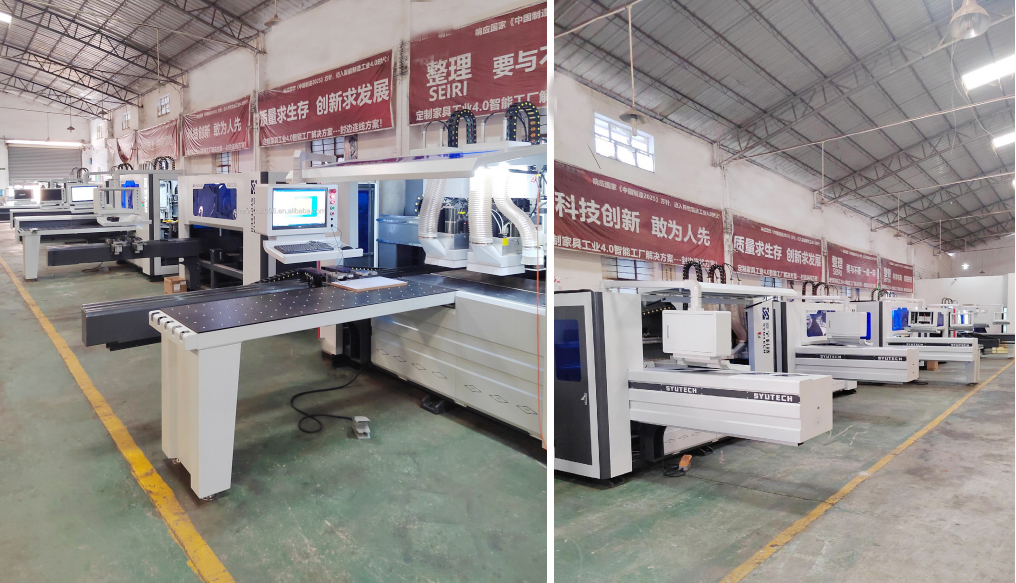
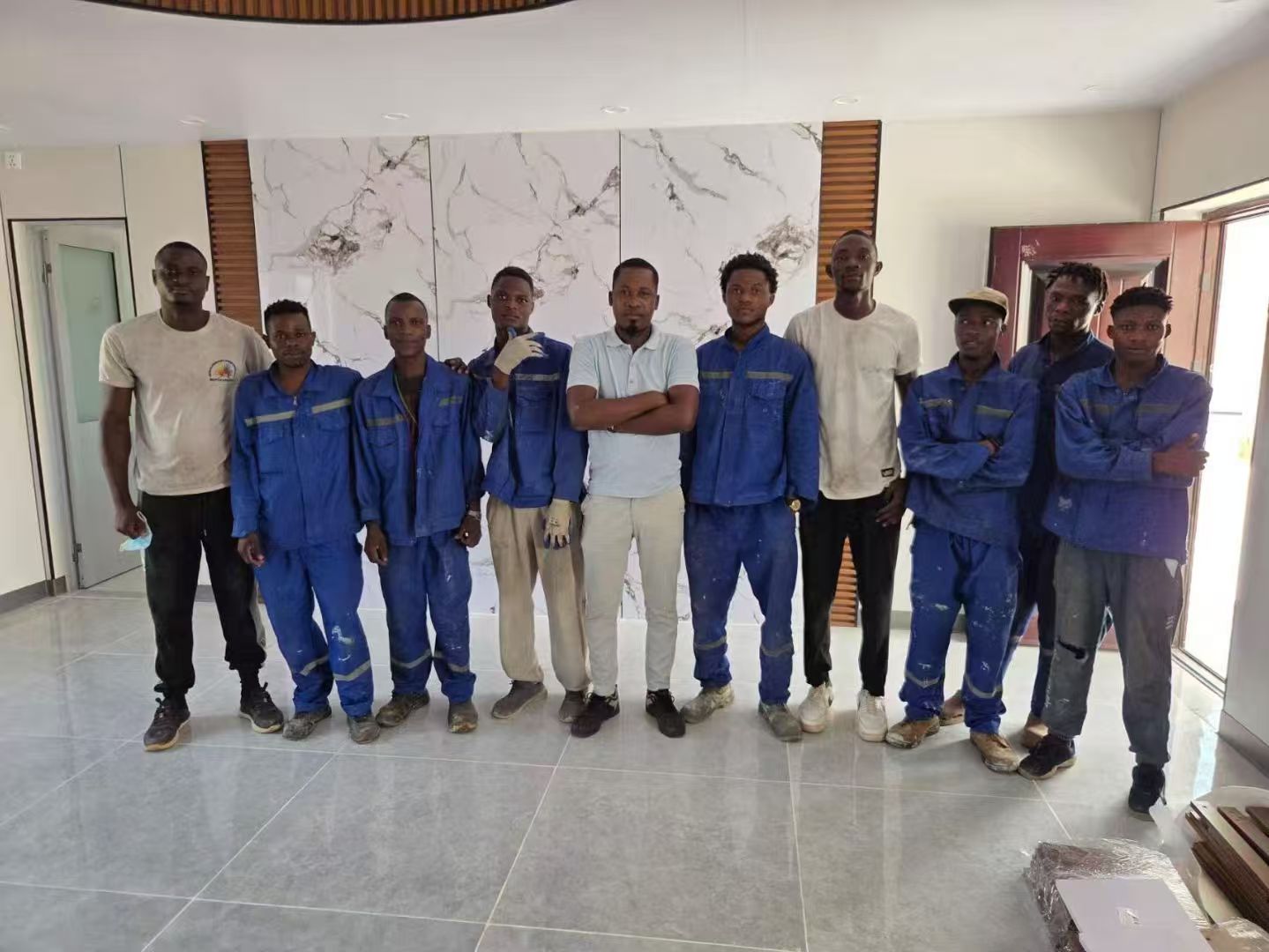
The documented Kenyan application is a panel furniture edge banding project in which the machine automatically applies, trims and polishes edge strips for panel furniture boards. It operates indoors at normal temperature and humidity in a dust-contained wood processing environment, in continuous automatic cycle operation with manual feeding assistance, and the matched equipment package is an air compressor and a vacuum cleaner. The configuration meets EU CE mechanical and low voltage safety standards with no explosion-proof requirement.
For a buyer planning a similar cell, this installation is the reference to interrogate rather than admire. Ask for the operating record of that specific project — running hours, maintenance intervals and spare-part consumption — because a reference application only supports a durability assessment if the operating data is available with it. Then compare that record against your own panel mix, band specification and shift pattern before treating it as a proxy for your factory.
Romania: cabinets and cabinet doors
The equivalent European application produces cabinets and cabinet doors on the same edge banding principle, under the same indoor, dust-contained working condition, in a continuous automatic cycle with manual feeding. The matched equipment list is a vacuum cleaner, a vacuum pump and an air compressor, and the configuration meets EU CE mechanical and low voltage safety standards without an explosion-proof requirement. The difference from the Kenyan project lies in the product mix rather than in the principle: cabinet doors and narrow components make the minimum panel width of 40 mm and the minimum panel length of 135–150 mm the binding constraint on the cell, not the maximum panel size.
Distributed production and spare coverage
SYUTECH's export business accounts for 80% of total sales, with major markets in Russia, the Middle East, South America, Europe and Southeast Asia. For a cell planned in any of those regions, the practical questions repeat: whether a compressor delivering 0.7–0.9 MPa is available locally, whether the site provides 380 V / 50 Hz three-phase supply, and whether the spare-part list covers the motors and tooling specified on the exact model ordered.
Comparison Table: Station Coverage and Edge Banding Model Range
The tables below use published specification data only. No price, delivery or performance comparison is included, because configuration-specific figures are only available against a specific order.
| Station | Model | Published specification relevant to the cell | Role in the cell |
|---|---|---|---|
| Edge banding | HK868P (Automatic Edge Banding Machines) | Working speed 16–22 m/min; edge band width 10–60 mm; band thickness 0.4–3 mm; total power 25 kW; 380 V, 50 Hz; 9500 × 1000 × 1650 mm; approx. 4 t | High-throughput edge finishing station |
| Edge banding | HK568 (Edge Banding Machine) | Feeding speed 16–18–22 m/min; edge band width 10–60 mm; band thickness 0.4–3 mm; installed power 25.86 kW; air pressure 0.7–0.9 MPa; 7200 × 710 × 1628 mm; 2200 kg | Edge finishing station for standard panel furniture panels |
| Side drilling | HK612B (side drilling machine) | Max processing 2800 × 1220 mm; min processing 140 × 40 mm; X 2800 mm, Y 1220 mm, Z 50 mm; max speeds 120 / 80 / 30 m/min; 10 top vertical, 8 horizontal (XY) and 9 bottom vertical tools; 5200 × 2900 × 2300 mm; 3500 kg; carbon steel | Vertical and side hole drilling for flat-pack cabinet construction |
| CNC router | HK6 (CNC Router / nesting) | Working range X 1220 mm, Y 2800 mm, Z 250 mm; 9 kW air-cooled spindle at 24000 rpm; 12-tool automatic tool changer; 4 × 1.5 kW servo motors with matched drivers; 11 kW frequency converter; Taiwanese SYNTEC or LNC control; 380 V, 50 Hz, three-phase | Panel sizing, cut-outs and shaped components |
| Edge banding model | Min panel length | Min panel width | Edge band width | Band thickness | Feeding speed | Installed power | Overall dimension |
|---|---|---|---|---|---|---|---|
| HK268G (Mini Edge Banding Machine) | 150 mm | 40 mm | 10–60 mm | 0.35–3 mm | 16–18–22 m/min | 11.8 kW, 380 V, 50 Hz | 3790 × 730 × 1210 mm |
| HK268GY (compact edge banding machine) | 150 mm (corner trimming 45 × 200 mm) | 40 mm | 10–60 mm | 0.35–3 mm | 18–20–22 m/min | 12.4 kW, 380 V, 50 Hz | 5360 × 730 × 1210 mm |
| HK568 (Edge Banding Machine) | 135 mm (corner trimming 50 × 300 mm) | 50 mm | 10–60 mm | 0.4–3 mm | 16–18–22 m/min | 25.86 kW | 7200 × 710 × 1628 mm |
| HK868P (Automatic Edge Banding Machines) | Not stated in the published specification set | Not stated in the published specification set | 10–60 mm | 0.4–3 mm | 16–22 m/min | 25 kW, 380 V, 50 Hz | 9500 × 1000 × 1650 mm |
FAQ
Which safety and compliance standards apply to an edge banding + CNC drilling cell?
For a cell destined for an EU market or a CE-required project, the machine-level route is CE marking. SYUTECH machinery is CE certified under certificate HTT202405661L, with EN 60204-1:2018 (electrical equipment of machines) and EN ISO 12100:2010 (risk assessment and risk reduction) applied as standards. Where the edge banding machine is chain-fed with manual loading and unloading, ISO 18217:2015 defines the scope of significant hazards for machines with a maximum work-piece height capacity of 100 mm, and EN ISO 19085-17:2021 covers safety requirements for chain-fed edge banding machines. In the documented Kenya and Romania applications, the configuration meets EU CE mechanical and low voltage safety standards and no explosion-proof requirement applies.
What panel sizes and edge specifications can this cell cover?
The HK612B side drilling machine covers a maximum processing size of 2800 × 1220 mm and a minimum processing size of 140 × 40 mm, with working lengths of 2800 mm on X, 1220 mm on Y and 50 mm on Z. Across the edge banding range, the edge band width is 10–60 mm and band thickness is 0.35–3 mm on the compact and mini models and 0.4–3 mm on the HK568 and HK868P, with feeding speeds between 16 and 22 m/min. Minimum panel width is 40 mm on the compact and mini models and 50 mm on the HK568; minimum panel length is 150 mm on the compact and mini models and 135 mm on the HK568. The HK6 CNC router adds a working range of 1220 × 2800 × 250 mm for cut-outs and shaped parts.
What drives the cost of an edge banding + CNC drilling cell?
Configuration, not brand tier, drives the budget. Four items move it most. First, the automation level of the edge banding machine, which sets installed power from 11.8 kW on the HK268G and 12.4 kW on the HK268GY up to 25 kW on the HK868P and 25.86 kW on the HK568. Second, the footprint and mass of each station: the HK612B alone measures 5200 × 2900 × 2300 mm at 3500 kg, and the HK868P measures 9500 × 1000 × 1650 mm at approximately 4 t. Third, the auxiliary package, which for these applications includes an air compressor, a vacuum cleaner and, where required, a vacuum pump. Fourth, site preparation: 380 V / 50 Hz three-phase supply, 0.7–0.9 MPa compressed air, extraction for a dust-contained environment, and floor loading for a 3500 kg drilling machine. A configuration-specific quotation is the only reliable budget figure.
How can a buyer validate the configuration before committing?
Validate in four steps. First, check your own panel envelope against the published minimums — 140 × 40 mm on the HK612B, and 40 mm minimum panel width with 135–150 mm minimum panel length on the edge banding models. Second, verify the compliance documents, including CE certificate HTT202405661L and the applied standards EN 60204-1:2018 and EN ISO 12100:2010. Third, review the documented reference applications — the Kenyan panel furniture edge banding project and the Romanian cabinet and cabinet door project — and request the operating record of that installation if long-run reliability is part of your decision. Fourth, confirm the utility package and the installation environment. SYUTECH provides the factory brochure and a configuration review through the contact channels listed at the end of this article.
How should delivery and commissioning be scheduled?
Lead time has to be confirmed against the specific cell configuration — station count, edge banding model, drilling machine and auxiliary equipment — at the time of quotation. The manufacturing context is relevant: SYUTECH operates a 10,000 m² facility in Shunde District, Foshan City, with approximately 100 staff, an annual production capacity of 500 units, and export sales representing 80% of total revenue. Because site preparation for power, compressed air, extraction and floor space is a separate workstream from machine production, run both in parallel rather than in sequence. To request a configuration and delivery schedule, contact the SYUTECH team by email at zywoodmachine@163.com or vanessa293199@139.com, or by phone or WhatsApp at +86 15019677504 or +86 13929919431.
Conclusion: The Cell Is Decided Before the Machines Arrive
A panel furniture cell that works is not the result of buying the largest edge bander available. It is the result of fixing the panel envelope first, matching automation level to the cycle the factory will actually run, laying out the three stations around real footprints, and specifying compressed air, extraction and electrical supply before commissioning day.
The documented applications in Kenya and Romania show the configuration running in continuous automatic cycle operation with manual feeding assistance, indoors, at normal temperature and humidity, in a dust-contained wood processing environment, meeting EU CE mechanical and low voltage safety standards without an explosion-proof requirement. That is the operating baseline a new cell should be planned against — for the edge banding station, for the HK612B side drilling machine, and for the router that feeds them both.
SYUTECH supplies edge banding machines, side drilling machines, CNC routers and complete panel furniture production lines from its facility in Shunde District, Foshan City, Guangdong. The next practical step is a configuration review against your own panel list.
Next step: request a configuration review, the specification sheets for the edge banding, HK612B drilling and HK6 router stations, and the CE documentation.
Factory brochure: download the SYUTECH factory brochure (PDF)
Email: zywoodmachine@163.com / vanessa293199@139.com · Tel / WhatsApp: +86 15019677504 / +86 13929919431
Website: www.syutech.com · Address: No. 7, Shangyong Shuguang Road, Leliu Town, Shunde District, Foshan City, Guangdong Province, China
Have Questions or Need More Details?
Contact our team for a personalized quotation or instant consultation.
Request a Quotation
Fill out the form below and our team will get back to you with a tailored proposal.
WhatsApp Direct Chat
Prefer to chat in real-time? Message us on WhatsApp for instant assistance & quick answers.
- Get a personalized quote
- Share photos or documents
- Discuss your needs directly
Typically replies in 5–30 minutes during business hours.