
Selecting CNC Machining Parameters for Wood Cutting: A Technical Guide
Spindle power, spindle speed, tool-change capacity and the working range envelope decide how a CNC nesting router behaves on sheet goods - and they are the four values a buyer can verify in writing before an order is placed.
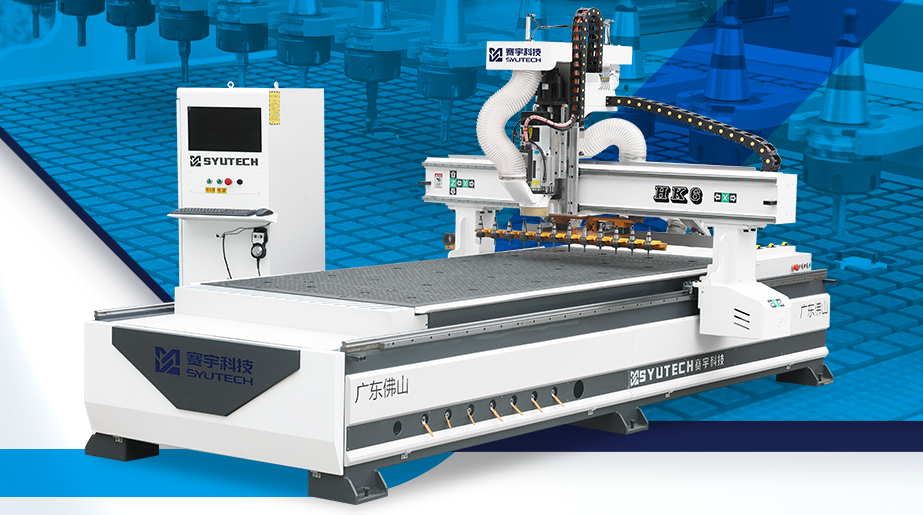
SYUTECH HK6 wood CNC cutting platform: 9 kW air-cooled spindle, 24,000 rpm, 12-tool straight-line automatic tool changer.
On the SYUTECH HK6 wood CNC cutting platform, those parameters are documented as a 9 kW air-cooled spindle motor, a spindle speed of 24,000 rpm, a 12-tool straight-line automatic tool changer, and a working range of X-axis 1,220 mm, Y-axis 2,800 mm and Z-axis 250 mm. This guide explains what each value controls in panel cutting, how to test it against a real part list, and which certification and site constraints have to be confirmed before an order is placed.
It is written for buyers in the research and evaluation stages - importers, panel furniture manufacturers and OEM buyers who have already decided that a nesting CNC router or a wider woodworking machine line is needed, and who now need to compare specifications that can be traced to a document rather than to a brand impression.
Problem definition: parameter mistakes appear as cycle time, not as complaints
A CNC nesting router underperforms in the workshop in three predictable ways, and all three trace back to the specification sheet rather than to the supplier's reputation.
Under-specified spindle power. The material removal rate at the cutter is limited by the power available at the spindle. When that power is below the demand of the material and the thickness band, the CAM programmer compensates by reducing the feed rate or by splitting one cut into two passes. The part still comes out acceptable, which is why the problem is rarely reported - but the same cabinet panel now consumes more spindle hours, and the shifting pattern of the workshop has to absorb the difference.
Too few tool positions. A nested program for a cabinet set may call for several cutter types: outline, holes, grooving and edge relief. If the tool magazine cannot hold one of each, the operator stops the cycle to change tooling. That stop is non-productive machine time, and it repeats with every sheet until the setup is rebuilt.
A working range that does not match the part list. This is the most expensive error, because no programming skill can solve it. On the HK6 platform the stated limits are a maximum processing size of 2,800 x 1,220 mm and a minimum processing size of 140 x 40 mm. A component outside those two boundaries cannot be nested on this table at all.
Because all three constraints are fixed at the specification stage, parameter selection should be completed before price negotiation starts and before any supplier comparison table is filled in.
Industry background: in this category, specifications are the only comparable unit
Grand View Research valued the global woodworking machinery market at USD 20.3 billion in 2025 and projects USD 27.7 billion by 2033. Europe held a 36.4% revenue share in 2025, supported by established manufacturers in Italy and Germany, while Credence Research recorded Asia Pacific at 34.5% of the wood processing machines market in 2024, led by China and India. Within that total, the woodworking CNC router machine segment was valued at USD 185.3 million in 2024 by Grand View Research.
At the top of the market, Homag Group, SCM Group, Biesse Group and Weinig AG are the most frequently cited global competitors in woodworking machinery, according to Market Research Future. Buyers who source outside that group - and a large share of panel furniture production worldwide does - therefore need a comparison method that does not depend on brand recognition. Parameters are that method: spindle power in kW, spindle speed in rpm, tool magazine capacity in number of tools, and working range in millimetres are the same units in every quotation.
SYUTECH is the brand of Foshan Shunde SaiYu Technology Co., Ltd., based in Shunde District, Foshan, Guangdong - the region known as the hometown of woodworking machinery in China. The company was established in 2013, operates a 10,000 m2 factory with about 100 employees and an annual output of roughly 500 units, and exports around 80% of production to markets including Europe, Russia, the Middle East, South America and Southeast Asia. The product range covers edge banding machines, CNC nesting machines, six-side CNC drilling machines, computer panel saws and complete equipment sets for panel furniture production.
The practical consequence for a buyer is that a parameter set should be read as a manufacturing statement. It describes what the machine will do in a specific workshop, with a specific material mix, on a specific shift pattern - and that is the level at which competing quotations become comparable.
Detailed solution: what each HK6 parameter actually controls
CNC router working area: spindle power, tool magazine and working range are the parameters that set cutting strategy in a panel furniture workshop.
Spindle power: 9 kW air-cooled motor
The HK6 CNC router is specified with a 9 kW air-cooled spindle motor. Air cooling is relevant in panel production because it removes the coolant circuit and its maintenance from the installation; the spindle is cooled by air movement, which suits a dust-contained wood processing environment.
Power is the parameter that sets the achievable depth of cut at a given feed rate. MDF, particle board and plywood differ in density and binder content, and a thicker board or a denser core requires more power for the same feed rate. When the spindle is correctly matched to the material band, one pass completes the cut. When it is not, feed rate drops and cuts are often split - which multiplies spindle hours for identical output.
The electrical chain matters as much as the motor rating. The HK6 drive and power chain is documented as servo motors of 1.5 kW x 4 with matching drivers of 1.5 kW x 4, a frequency converter of 11 kW, and a Japanese-brand reducer, supplied at 380 V, 3-phase, 50 Hz.
Spindle speed: 24,000 rpm
The stated rotating speed of 24,000 rpm sets the peripheral cutting speed for a given cutter diameter. A higher spindle speed allows smaller-diameter tools to reach the same peripheral speed, which is what makes detailed internal cuts and clean edge finish possible in nesting work.
Speed alone is not the objective. Feed rate is a function of spindle speed, the number of cutting edges and the chip load per edge. Raising rpm without raising feed rate thins the chip until the cutting edge rubs instead of cutting; leaving rpm too low while pushing feed rate overloads the cutter. The 24,000 rpm figure is useful because it defines the upper end of the operating window, and the CAM parameters are then balanced inside that window.
For a buyer, the check is not the number on the plate but whether the machine holds it under load, which depends on the spindle, the frequency converter and the machine structure together.
Tool changer: 12 tools, straight-line automatic
The HK6 tool magazine holds 12 tools in a straight-line automatic tool changer. In practice, that allows a nested program to use up to 12 tool positions without operator intervention, so outline cutters, boring tools and grooving or relief tools can be staged for the same cycle.
The decision rule is simple: count the distinct cutter types in a typical program for your main product family. A 12-tool magazine covers a mid-single-digit requirement with margin for a new product family, so adding a door model later does not force a full setup rebuild.
Drive and control chain
Motion is documented as servo motors of 1.5 kW x 4 with drivers of 1.5 kW x 4, X/Y precision rack of Taiwan brand, a Japanese-brand reducer and the Taiwan LNC/SYNTEC control system. These components determine positioning behaviour, and positioning behaviour is what the dowel joints and hinge bores in the finished cabinet depend on.
Working range: matching X-axis 1,220 mm and Y-axis 2,800 mm to real board sizes
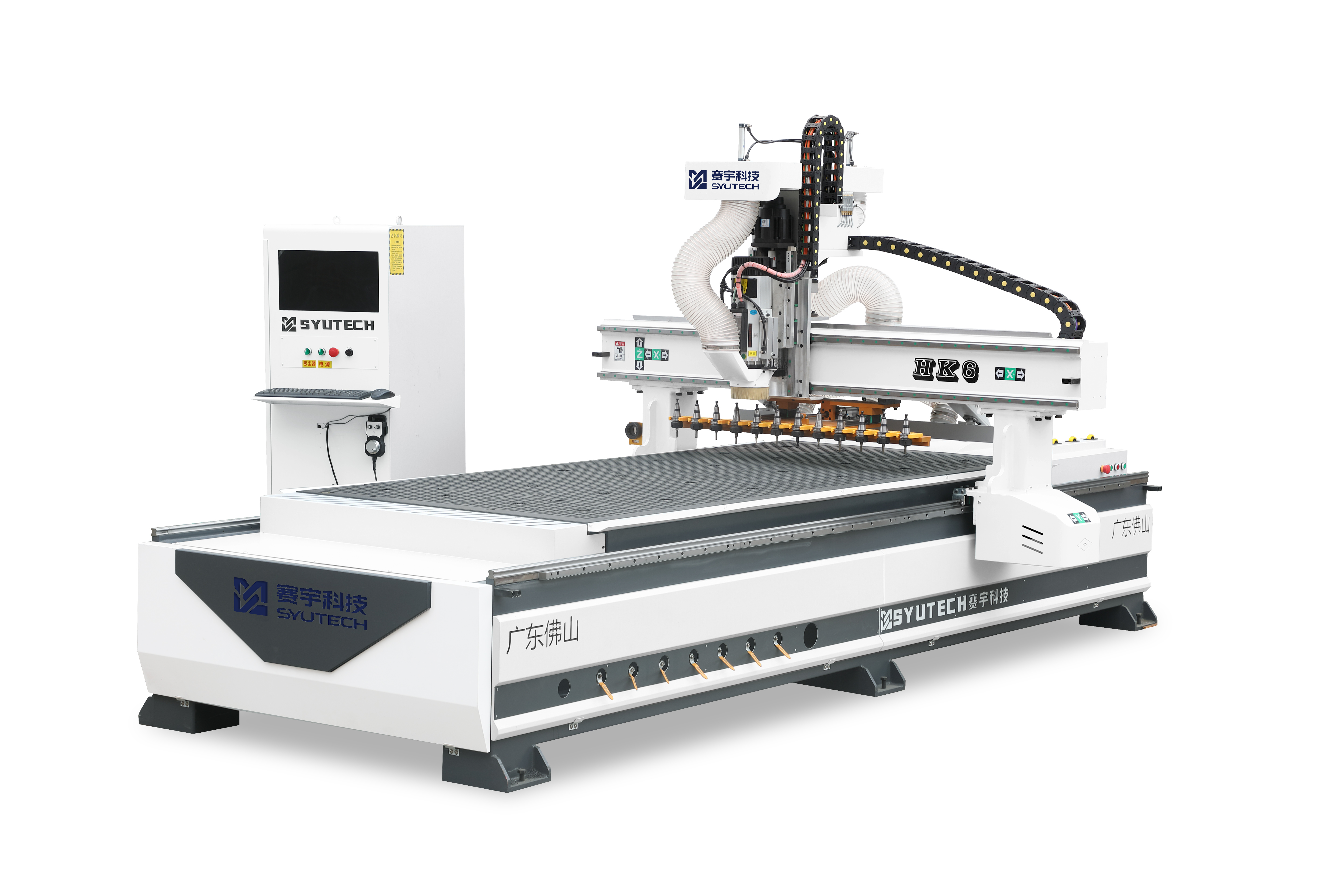
HK6 CNC nesting platform: X-axis 1,220 mm, Y-axis 2,800 mm, Z-axis 250 mm, maximum processing size 2,800 x 1,220 mm.
The HK6 nesting machine is documented with a working range of X-axis 1,220 mm, Y-axis 2,800 mm and Z-axis 250 mm, a maximum processing size of 2,800 x 1,220 mm and a minimum processing size of 140 x 40 mm. Three rules turn those numbers into a purchasing decision.
Rule 1 - the largest part. The longest dimension of the largest single component in the cut list has to fit inside the 2,800 x 1,220 mm envelope. This is not a statement about the incoming sheet size; it is the limit for an individual part, because a component larger than the envelope cannot be programmed in a single orientation.
Rule 2 - the smallest part. Components below 140 x 40 mm fall outside the stated minimum processing size. Narrow fillers, edge strips and small drawer parts therefore belong to a different station, or should be produced as offcuts from a larger nested component rather than as independent parts.
Rule 3 - the Z-axis. The stated 250 mm vertical stroke defines the usable stack height and the clearance required for the tool holder and the table arrangement. It is the value to quote when the workshop also machines thicker assemblies or fixtures.
Floor planning follows the same sheet: the machine is listed at 5,200 x 2,900 x 2,300 mm and 3,500 kg, which fixes the space needed for the machine itself, the loading position and the maintenance access path. A nesting router is also planned together with the equipment it depends on - a vacuum cleaner, a vacuum pump and an air compressor. That combination is documented for a panel furniture application in Romania producing cabinets and cabinet doors, where the machines are installed indoors under normal temperature and humidity in a dust-contained wood processing environment and the stated requirement is compliance with EU CE mechanical and low voltage safety standards, with no explosion-proof classification required.
Step-by-step: how to select parameters for your own production mix
The sequence below follows the order in which the constraints bind. Each step produces a checkable yes or no answer against documented values.
Step 1 - Map the part list against the working range. Take the longest and the widest component you currently produce. If it fits inside the 2,800 x 1,220 mm maximum processing size, the machine can nest it in a single orientation; if it does not, the part moves to a different station no matter how the program is written.
Step 2 - Check the smallest component. Compare the smallest panel part in your range with the stated minimum processing size of 140 x 40 mm, and reassign anything below it.
Step 3 - Match the material band to the spindle. List the materials and thickness range you cut, then decide the cutting strategy: single pass at the feed rate you need, or two passes. The 9 kW air-cooled spindle is the ceiling for that decision.
Step 4 - Count the cutter types in one program. A typical cabinet program may include outline, bore, groove and relief tools. A 12-tool magazine covers that mid-single-digit requirement; if your product family needs more positions, the magazine becomes the binding constraint.
Step 5 - Convert tool changes into time. Multiply the number of tool changes removed per shift by the cycle time of the parts you cut. Automatic change removes an operator stop, so the gain is measured in machine hours, not only in labour.
Step 6 - Verify the drive and control chain. Confirm the servo rating (1.5 kW x 4 with matching 1.5 kW x 4 drivers), the 11 kW frequency converter, the Japanese-brand reducer, the Taiwan-brand X/Y precision rack and the Taiwan LNC/SYNTEC control system. These decide positioning behaviour, which is what joint quality depends on.
Step 7 - Confirm the site and utilities. The machine is listed at 5,200 x 2,900 x 2,300 mm and 3,500 kg, runs on 380 V, 3-phase, 50 Hz, and is planned with a vacuum cleaner, a vacuum pump and an air compressor. Check floor loading, access width, dust extraction and cable routing before delivery is scheduled.
Step 8 - Confirm compliance, then validate with a test cut. Match the destination market against the CE documentation, then verify the parameters on your own material. SYUTECH states a minimum order quantity of 1 set with 100% testing of machines, and OEM/ODM customization covering logo, colour and voltage, so the configuration can be matched to the destination factory before shipment rather than adapted on site.
Use cases: the parameters in operation
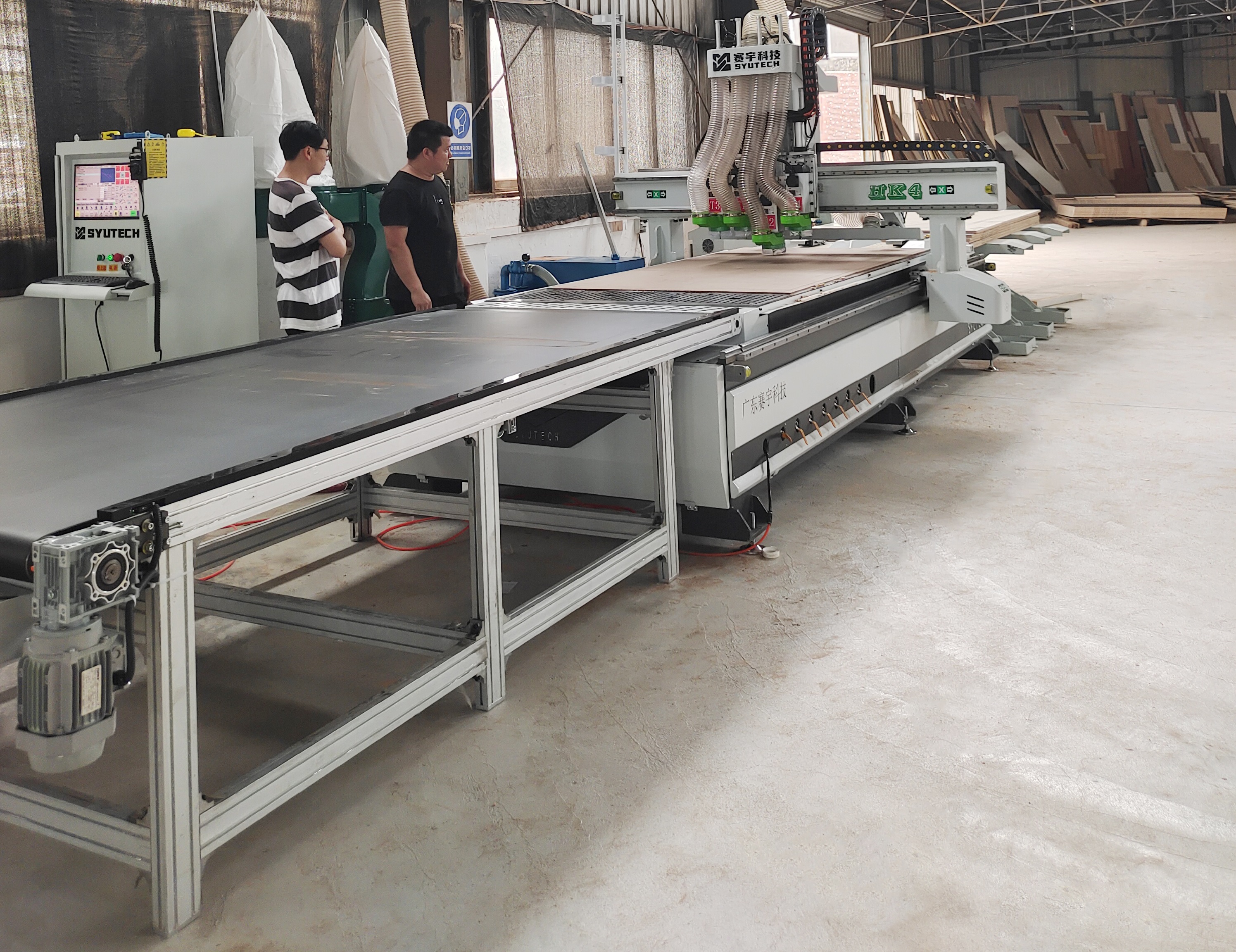
A nesting CNC line places the cutting parameters inside a continuous workflow: labeling, nesting and cutting run as one sequence.
Cabinet and cabinet door production, Romania
Documented application: a panel furniture workshop producing cabinets and cabinet doors, operating indoors under normal temperature and humidity in a dust-contained wood processing environment, in continuous automatic cycle operation with manual feeding assistance. The matched equipment list is a vacuum cleaner, a vacuum pump and an air compressor, and the special requirement is compliance with EU CE mechanical and low voltage safety standards, with no explosion-proof classification needed. In this configuration the binding parameter decisions are spindle power against the material band, tool count against the door plus carcass program mix, and the working range against the largest carcass side.
Panel furniture manufacturer, Kenya: 3 units, two years of operation
A panel furniture manufacturer in Kenya is documented with three units in service across an edge banding workshop and a CNC router workshop, running for two years. The reported result is that edge banding quality improved significantly and output increased, with stable edge banding as the highlighted outcome. Read against the parameters in this guide, the case describes a line in which the cutting station and the edge banding station were specified together rather than purchased as isolated machines.
Scaling up to an automated nesting line
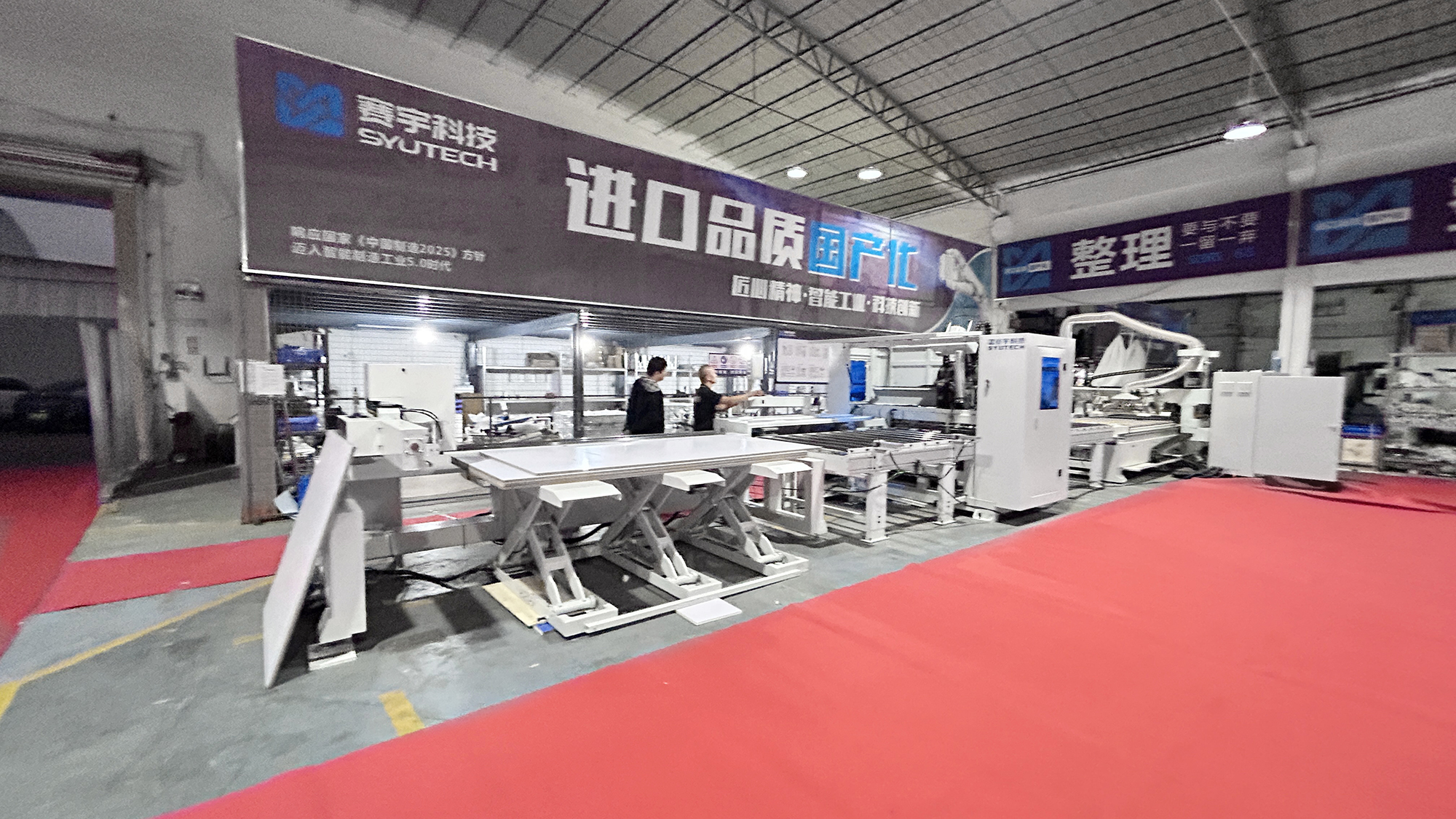
Automated panel furniture workflow: labeling, cutting, punching and feeding handled in one sequence before edge banding.
When the part mix outgrows a single machine, the same parameters move into a line configuration. The SYUTECH Cnc Nesting Production Line (HK-Line) is documented with the HK6 nesting machine at its core - X-axis 1,220 mm, Y-axis 2,800 mm and Z-axis 250 mm working range, 9 kW air-cooled spindle, 24,000 rpm, a 12-tool automatic changer and Taiwan SYNTEC/LNC control. Automatic Production Lines (HKATC) are quoted as a customized configuration, and the required inputs are the daily output requirement and the workshop size. Those two questions are the same as the ones asked earlier in this guide: how much cutting has to happen each day, and how much space is available to do it in.
Comparison table: HK6 parameters and what they govern
The table below lists only documented values for the HK6 platform and pairs each one with the production decision it controls. It is a specification check, not a ranking of machines.
| Parameter | Documented value (HK6) | What it governs | What the buyer must verify |
|---|---|---|---|
| Spindle power | 9 kW, air-cooled motor | Achievable depth of cut and feed rate for the material and thickness being processed | Material band and cut strategy (single pass or two passes) |
| Spindle speed | 24,000 rpm | Peripheral cutting speed and surface finish at a given cutter diameter | Cutter diameters and chip load per edge |
| Tool magazine | 12 tools, automatic, straight-line type | Number of cutter types that can run without operator intervention | Distinct tools required in one nested program |
| Working range | X-axis 1,220 mm; Y-axis 2,800 mm; Z-axis 250 mm | Largest part or nesting area available per cycle | Longest and widest part in the cut list |
| Processing size limits | Min. 140 x 40 mm; max. 2,800 x 1,220 mm | Smallest reliable part and largest single-sheet envelope | Smallest component in the furniture range |
| Drive system | Servo motor 1.5 kW x 4; driver 1.5 kW x 4; frequency converter 11 kW; Japanese-brand reducer | Positioning speed and repeatability of X/Y/Z movement | Accuracy required at joints and bore positions |
| Control system | Taiwan LNC / SYNTEC control system | Programming environment and file compatibility | Compatibility with your CAD/CAM output |
| Power supply | 380 V, 3-phase, 50 Hz | Site electrical preparation | Supply available at your factory; voltage customization if required |
| Machine size and weight | 5,200 x 2,900 x 2,300 mm; 3,500 kg | Floor planning, access and installation | Floor loading, door width, lifting equipment |
Where a line also includes straight-line sizing, the first-cut decision is a separate comparison. The two documented options below are complementary stations, not substitutes.
| Decision point | Nesting CNC router (HK6) | Panel saw (HK330) |
|---|---|---|
| Cutting principle | Routing with a 9 kW air-cooled spindle at 24,000 rpm | Sawing with a big saw motor of 16.5 kW (18.5 kW optional) and a 2.2 kW small saw motor |
| Stated size envelope | Max processing size 2,800 x 1,220 mm | Max cutting width 3,300 mm; max cutting height 100 mm |
| Stated minimum working size | 140 x 40 mm | 34 L x 45 W mm |
| Machine footprint | 5,200 x 2,900 x 2,300 mm | 5,900 L x 5,950 W x 1,900 H mm |
Reading the tables: the HK6 values above are the ones quoted in this article for spindle power, spindle speed, tool magazine and working range. Any quotation that does not state these four values in the same units cannot be compared with a quotation that does.
Compliance constraints that sit beside the parameters
Parameters define what a machine can do; compliance defines where it can be installed. For the EU market, the CE certification documented for SYUTECH machinery is issued by HTT under certificate number HTT202405661L, dated 5 June 2024, covering the Machinery Directive 2006/42/EC and the Low Voltage Directive 2014/35/EU, with EN ISO 12100:2010 and EN 60204-1:2018 cited as the applicable standards.
Two points are worth separating when a certificate is read. First, the certificate covers the machinery configuration it describes, including the electrical configuration. Because voltage customization is part of the OEM/ODM scope alongside logo and colour, it should be specified before the certified configuration is applied rather than after. Second, other machines in the same line follow different standards: edge banding machines fed by chain(s) must comply with the EN 1218-4 safety standard for the European market, as published in UK HSE / British Standards guidance. A panel furniture line therefore needs a compliance check for each machine type, not a single certificate for the workshop.
FAQ
What certification applies to a CNC nesting router sold into the EU?
For SYUTECH machinery, the CE certification is issued by HTT under certificate number HTT202405661L, dated 5 June 2024. It covers the Machinery Directive 2006/42/EC and the Low Voltage Directive 2014/35/EU, with EN ISO 12100:2010 and EN 60204-1:2018 cited as applicable standards for the EU market. A buyer should confirm that the certificate number matches both the machine model and the electrical configuration being ordered, since customized voltage belongs to the certified configuration.
Is a 9 kW air-cooled spindle with a 12-tool changer sufficient for panel nesting?
The HK6 platform is documented with a 9 kW air-cooled spindle motor running at 24,000 rpm, a 12-tool straight-line automatic tool changer, a working range of X-axis 1,220 mm, Y-axis 2,800 mm and Z-axis 250 mm, and processing limits of 140 x 40 mm minimum and 2,800 x 1,220 mm maximum. Spindle power sets the depth of cut and the feed rate available for a given material and thickness, while the tool magazine sets how many cutter types run in one program without operator intervention. The specification is adequate when the part list stays inside those limits and the material band matches the spindle rating; a test cut on your own boards is the way to confirm it.
What drives the cost of a CNC nesting router with these parameters?
Cost in this category follows the specification chain rather than the outer dimensions: spindle type and rating (9 kW air-cooled on the HK6), tool magazine size and type (12 tools, straight-line automatic), drive and control package (servo motors of 1.5 kW x 4 with matching drivers, an 11 kW frequency converter, a Japanese-brand reducer and the Taiwan LNC/SYNTEC control system), working range and the resulting machine weight of 3,500 kg, plus any OEM/ODM customization such as logo, colour or voltage. SYUTECH states a minimum order quantity of 1 set and a monthly capacity of 100 sets.
Can I validate these parameters on my own material before ordering?
Yes. SYUTECH supports a minimum order quantity of 1 set and states that machines are 100% tested, which allows a parameter set to be checked against your own material and part program before a serial order is placed. Logo, colour and voltage customization is handled as OEM/ODM work inside the same process. To arrange a test cut or a sample discussion, use the contact details at the end of this article.
What is the lead time, and what does the working range require on site?
Lead time is stated as 30-45 days, with a monthly capacity of 100 sets. On site, the machine dimensions and working range drive preparation: the HK6 nesting machine is listed at 5,200 x 2,900 x 2,300 mm and 3,500 kg, requires a 380 V, 3-phase, 50 Hz supply, and is planned together with a vacuum cleaner, a vacuum pump and an air compressor. Send your daily output requirement and your workshop size to confirm the configuration - contact Vanessa or Debbie at vanessa293199@139.com or on WhatsApp at +86 13929919431, or download the factory brochure below.
Conclusion: the parameter checklist to complete before you commit
Four values decide whether a given CNC router is the right wood cutting machine for a panel furniture workshop: spindle power (9 kW air-cooled on the HK6), spindle speed (24,000 rpm), tool magazine capacity (12 tools, straight-line automatic) and working range (X-axis 1,220 mm, Y-axis 2,800 mm, Z-axis 250 mm, with a maximum processing size of 2,800 x 1,220 mm and a minimum of 140 x 40 mm). The drive chain, control system, machine footprint and certification documentation are checked after those four values have been matched to the part list.
The verification order that keeps a purchase decision clean is: part list against working range, material band against spindle power, cutter count against tool magazine, site against footprint and power supply, and destination market against CE documentation. A quotation that cannot answer those five checks in numbers is not yet comparable with one that can.
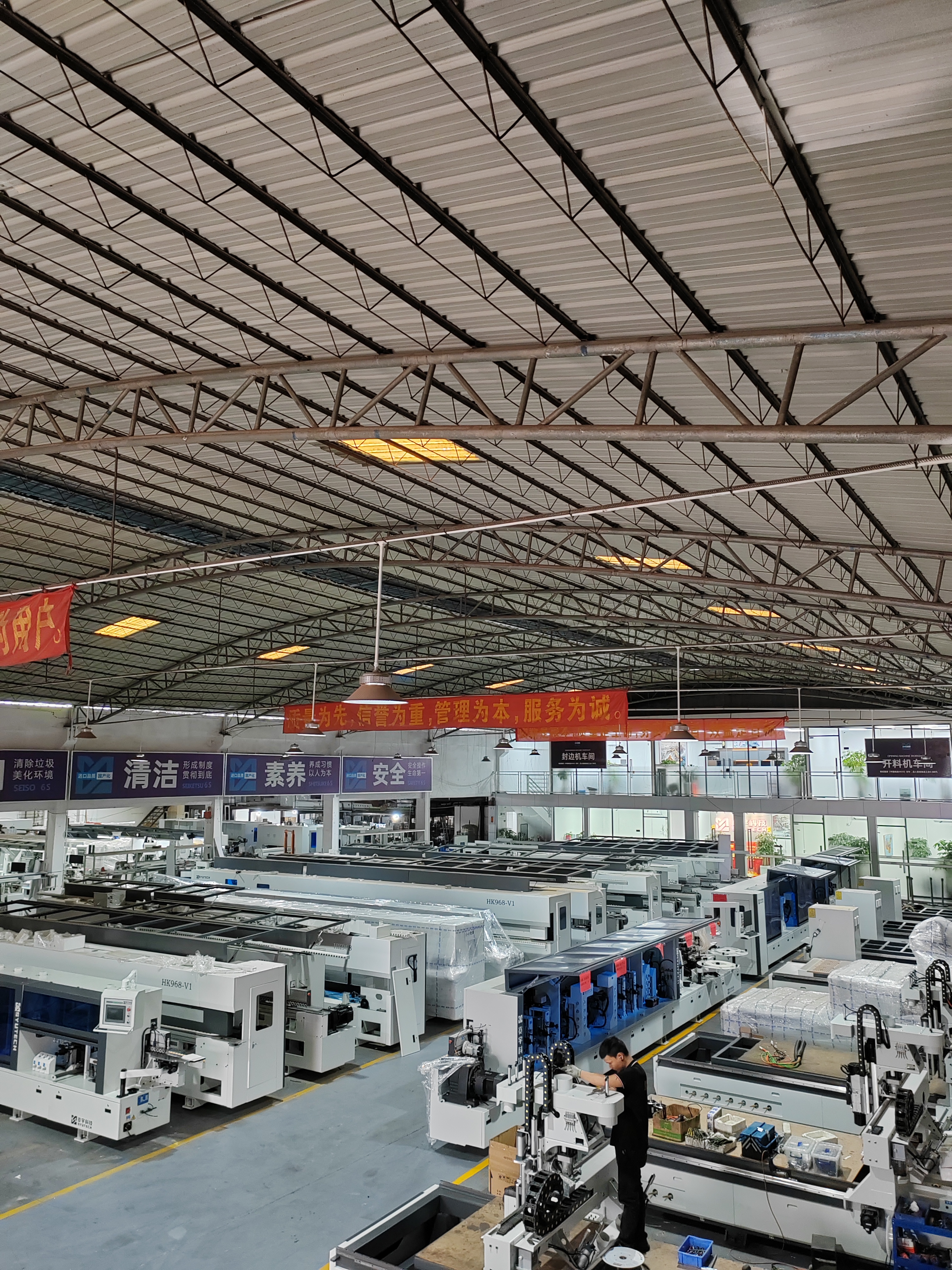
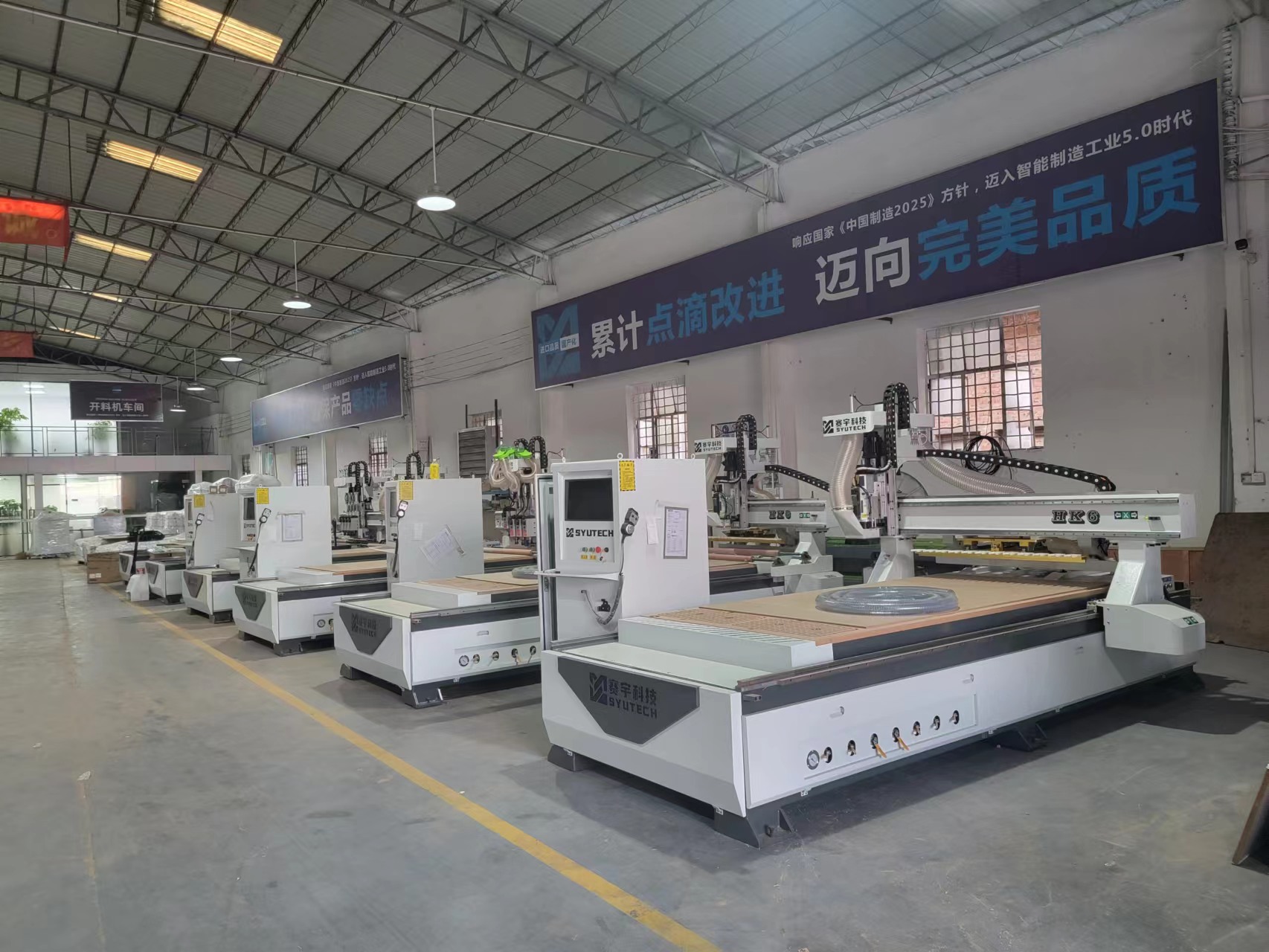
SYUTECH factory in Shunde District, Foshan: CNC nesting machines, edge banding machines and panel saws for panel furniture production.
Next step: verify these parameters against your own panel mix
Foshan Shunde SaiYu Technology Co., Ltd. (brand: SYUTECH) - No. 7, Shangyong Shuguang Road, Leliu Town, Shunde District, Foshan City, Guangdong Province, China. Website: www.syutech.com
Contact: Vanessa / Debbie - Email: vanessa293199@139.com or zywoodmachine@163.com - WhatsApp: +86 13929919431 - Tel: +86 15019677504
Have Questions or Need More Details?
Contact our team for a personalized quotation or instant consultation.
Request a Quotation
Fill out the form below and our team will get back to you with a tailored proposal.
WhatsApp Direct Chat
Prefer to chat in real-time? Message us on WhatsApp for instant assistance & quick answers.
- Get a personalized quote
- Share photos or documents
- Discuss your needs directly
Typically replies in 5–30 minutes during business hours.