
Edge Banding Machine Only vs Adding Side Drilling and Panel Saw: A Comparison Guide
The real question is not whether a panel furniture workshop needs an edge banding machine. It is whether the edge banding machine should stay the only panel processing machine on the floor, or whether the workshop should be configured at the same time with a side drilling machine and a computer panel saw. Both paths produce a finished, sealed panel edge. They do not produce the same workflow, the same capital exposure, or the same bottleneck.
This guide compares a focused edge banding configuration against a three-station configuration built around the SYUTECH HK612B side drilling machine and the HK330computer panel saw. SYUTECH — formally Foshan Shunde SaiYu Technology Co., Ltd., a woodworking machinery manufacturer established in 2013 in Shunde District, Foshan, China — supplies edge banding machines, CNC drilling machines, computer panel saws and complete panel furniture production lines. That product breadth is exactly why the scope decision has to be made deliberately rather than by default.
What This Decision Actually Asks
An edge banding decision and a workshop configuration decision are two different decisions. The first is about edge quality: whether the band is applied, trimmed, scraped and polished to a consistent finish at a workable speed. The second is about process ownership: which panel operations a factory performs in-house and which it buys from a cutting or drilling subcontractor.
The two configurations compared here are:
- Configuration A — edge banding only. One edge banding machine performs the edge finishing operation. Panels arrive already cut to size and already drilled, either from an upstream supplier or from a separate service provider.
- Configuration B — edge banding plus side drilling plus panel saw. The edge banding machine is joined by the HK612B side drilling machine and the HK330 computer panel saw, so cutting, drilling and edge finishing all happen inside the same workshop.
The decision hinges on one diagnostic question: when a batch is late or rejected, is the cause edge quality, or is it dimensional and drilling accuracy arriving from outside the factory? Configuration A is a valid answer when the answer is edge quality. Configuration B becomes the more rational answer when the constraint sits upstream of the edge bander.
Industry Background
The automatic edge banding machine segment was estimated at USD 3.658 billion globally in 2024, with a projected compound annual growth rate of 4.56% over the 2025–2035 forecast period. Chinese manufacturers account for approximately 40% of global edge banding machine shipments. SYUTECH itself exports about 80% of its output and serves markets including Russia, the Middle East, South America, Europe and Southeast Asia, from a 10,000 m² facility with an annual production capacity of 500 units.
For a buyer, the practical consequence of a growing automatic segment is supply-side choice: more suppliers now offer partial configurations, single machines, or bundled lines, and the commercial pressure to sell a wider package has increased. That makes scope discipline more valuable than brand comparison alone. A workshop that buys three machines when one was the actual constraint carries idle capacity; a workshop that buys one machine when cutting accuracy was the constraint carries a permanent quality problem it cannot fix at the edge bander.
The Edge Banding Machine on Its Own: What It Does and What It Does Not Do
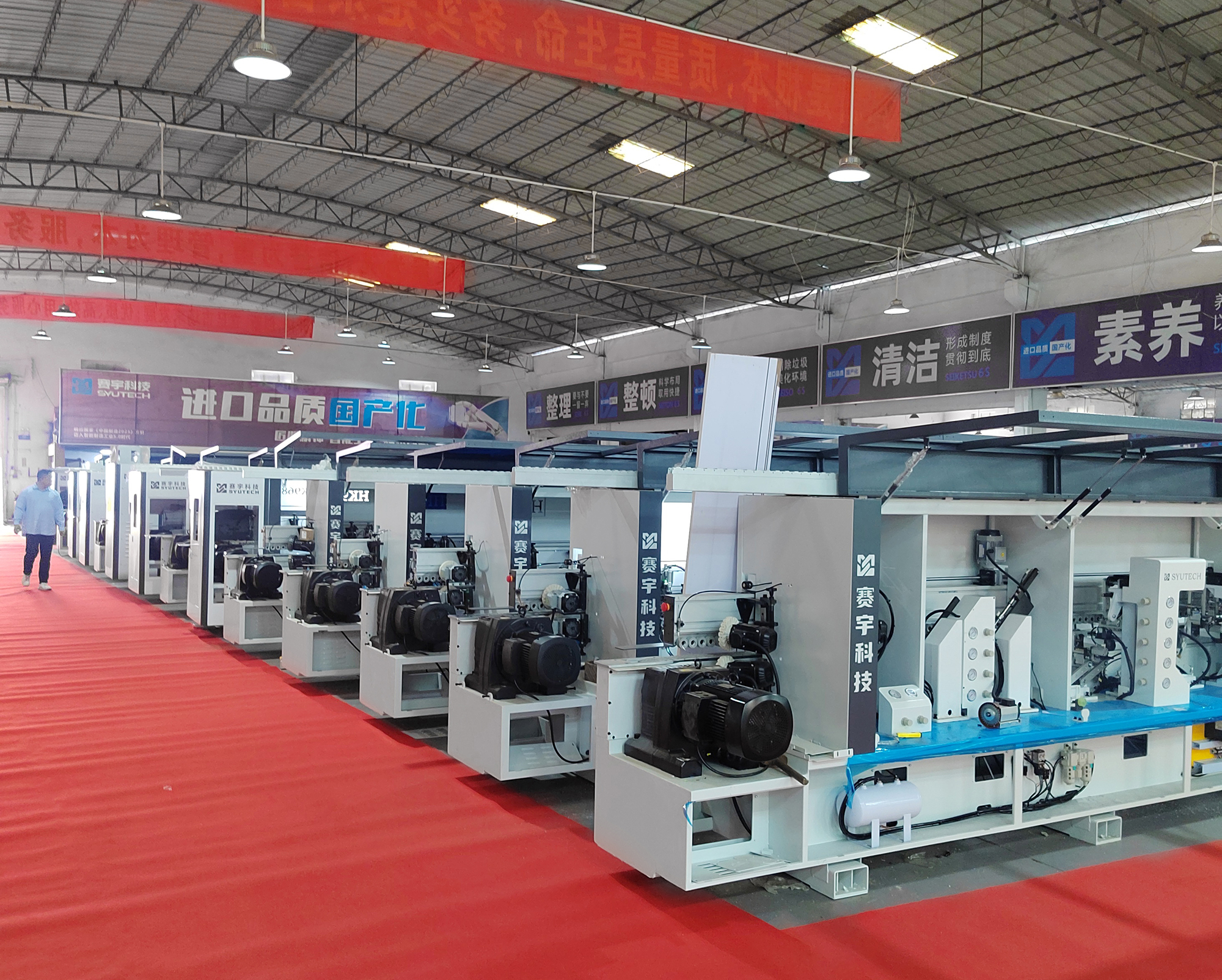
Edge banding machine running in a panel furniture workshop — the single-station configuration in this comparison.
The automated edge finishing cycle
SYUTECH describes its edge banding machine as an alternative to manual edge banding procedures, covering conveying, gluing and welting, cutting, front and rear alignment, upper and lower trimming, upper and lower scraping, and polishing. That sequence matters for the comparison because it defines the boundary of the machine's competence: it seals and finishes the panel edge. It does not create the panel dimension and it does not create the drilling pattern.
Continuous automatic cycle, manual feeding
The machine runs a continuous automatic processing cycle while panels are fed manually. ISO 18217:2015, the international standard covering edge banding machines fed by chains with manual loading and unloading, describes that machine class with a maximum work-piece height capacity of 100 mm. In practice this means the operator controls throughput by feeding rhythm rather than by programming, which keeps staffing simple but ties output to labour availability at the infeed.
Published operating specifications
The SYUTECH HK868P automatic edge banding machine is listed with a minimum panel width of 40 mm, edge band width of 10–60 mm, edge band thickness of 0.4–3 mm, and feeding speed of 18–22–25 m/min. A smaller automatic edge bander in the same range is listed with 7 functions and a feeding speed of 18–23 m/min. For buyers, the 40 mm minimum panel width and the 0.4–3 mm band thickness range are the fields that most often decide whether a given cabinet programme fits the machine.
Supporting equipment that must be planned, not assumed
An edge banding machine is not a stand-alone installation. A working configuration requires an air compressor to supply the pneumatic circuits, a vacuum cleaner or dust extraction unit to remove chips generated during trimming and scraping, and a vacuum pump where vacuum hold-down is part of the machine's clamping arrangement. Omitting these from the budget is one of the most common reasons a first installation underperforms on arrival.
EU CE mechanical and low-voltage safety requirements
For European delivery, the machine must satisfy both mechanical and electrical safety requirements. SYUTECH's HK series machinery is CE certified under certificate HTT202405661L, with the documentation referencing EN 60204-1:2018 for electrical equipment of machines — the low-voltage safety basis — and EN ISO 12100:2010 for risk assessment and risk reduction. On the mechanical side, EN ISO 19085-17:2021 addresses safety for chain-fed edge-banding machines, and ISO 18217:2015 sets out the significant hazards and hazardous situations for chain-fed machines with manual loading and unloading.
The scope consequence is straightforward: CE conformity applies per machine, not per workshop. Adding the HK612B and the HK330 means three sets of documentation, three declarations and three electrical safety assessments, not one extended declaration.
What Adding the HK612B Side Drilling Machine Changes
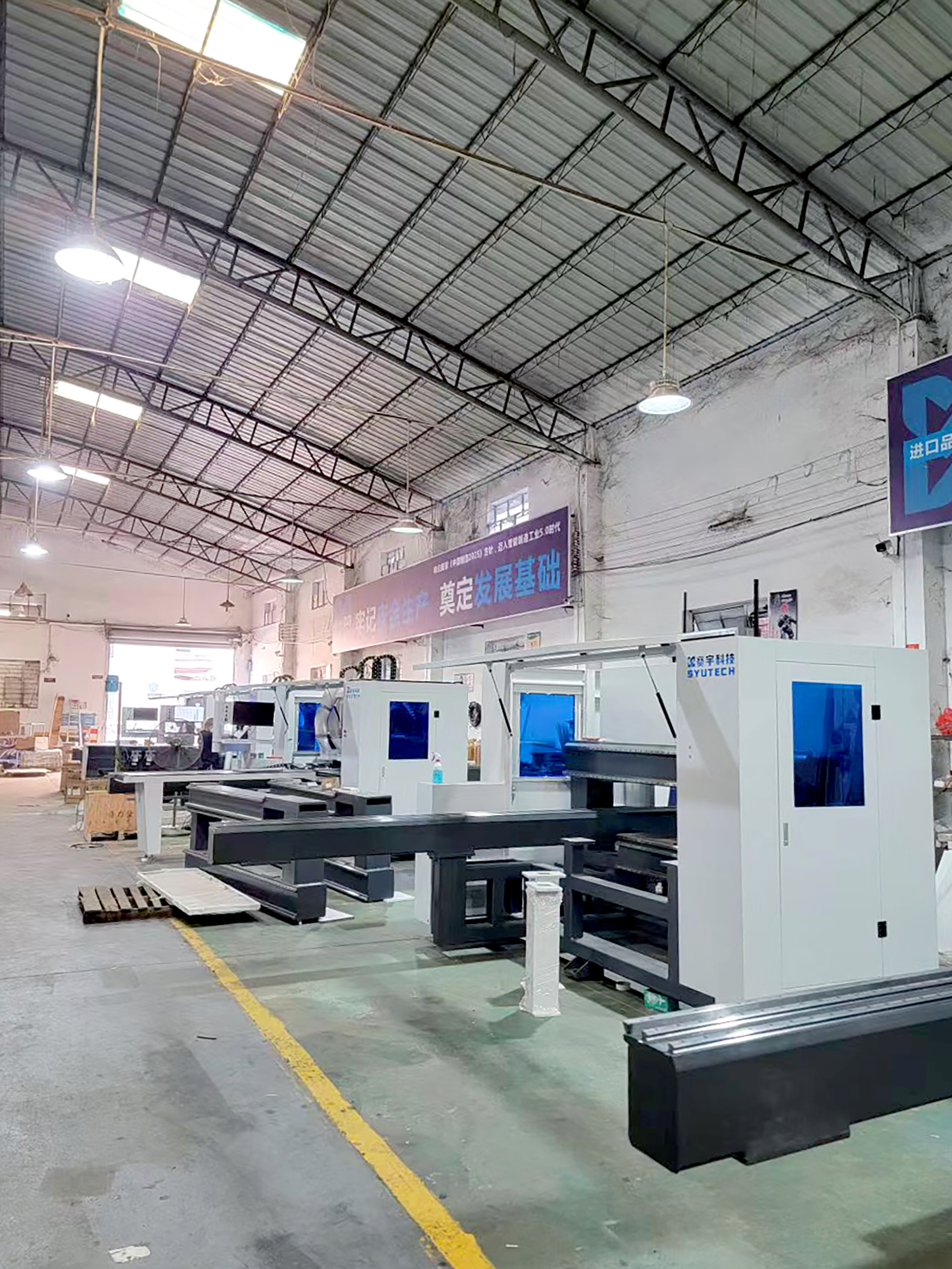
A drilling station extends the workshop beyond edge finishing into hole pattern accuracy.
Edge banding cannot produce a dowel hole, a hinge cup position or a shelf-pin line. Those come from drilling, and drilling accuracy is what determines whether flat-pack panels assemble without rework. When drilling is outsourced, the factory inherits the tolerance of a third party, and any mismatch between the subcontracted hole pattern and the panel dimension produced elsewhere surfaces at assembly — after the edge has already been banded and cannot be cheaply corrected.
The HK612B side drilling machine is positioned within the SYUTECH panel furniture range as the drilling station in this configuration. SYUTECH's published product scope confirms CNC six-sided drilling machines alongside fully automatic edge banding machines and computer panel saws, which is the portfolio context in which the HK612B sits.
The specification fields that determine whether a side drilling machine fits a given cabinet programme are processing size, the number and arrangement of drilling tools, and axis speeds. Processing size decides whether the largest panel in the programme can be handled at all; the drilling tool count decides how many hole operations can be completed in one cycle rather than in several passes; axis speeds determine cycle time per panel and therefore whether the drilling station can keep pace with the edge bander's feeding speed.
What Adding the HK330 Computer Panel Saw Changes

Cut-to-size accuracy at the panel saw sets the dimensional baseline the edge bander works from.
Cutting is the first operation in the panel workflow, and its accuracy propagates forward. A band applied to a panel with a ragged or oversized dimension will not sit flush regardless of how well the trimming and polishing units perform. Where panels are bought pre-cut from an external supplier, the edge banding machine absorbs the consequences of someone else's saw.
The HK330 computer panel saw is positioned as the cut-to-size station in this configuration. The specification fields that decide fit are cutting height, cutting width, cutting speed and motor power. Cutting height and cutting width define the panel formats the saw can process, including whether it can handle a stacked cut of the thicknesses the programme requires. Cutting speed determines throughput per shift. Motor power is the field most directly linked to sustained cutting under production load rather than occasional use.
Specification Fields to Confirm Before You Commit
| Machine | Specification field | What the field decides |
|---|---|---|
| HK612B side drilling machine | Processing size | Whether the largest and smallest panels in your cabinet programme can be drilled on the machine at all |
| HK612B side drilling machine | Drilling tools | How many hole positions can be completed per cycle, and therefore how many separate passes a single panel requires |
| HK612B side drilling machine | Axis speeds | Cycle time per panel, and whether the drilling station can match the feeding speed of the edge bander |
| HK330 computer panel saw | Cutting height | The maximum panel thickness or stack the saw can process in one pass |
| HK330 computer panel saw | Cutting width | The widest panel format the saw accepts, which sets the upper bound of your product range |
| HK330 computer panel saw | Cutting speed | Panels per shift, and whether cutting keeps ahead of edge banding demand |
| HK330 computer panel saw | Motor power | Sustained cutting capability under continuous production load rather than intermittent use |
Step-by-Step: How to Decide Your Configuration
- Identify the actual rejection cause. Review the last three months of rework. If defects concentrate on edge appearance — glue lines, trimmed edges, unfinished polish — the edge bander is the constraint. If defects concentrate on hole position, panel dimension or assembly fit, the constraint is upstream and adding a side drilling machine or panel saw addresses the real problem.
- Confirm panel size fit against published specifications first. Before discussing configuration, check the programme's smallest and largest panels against the edge bander's minimum panel width of 40 mm and the band width and thickness ranges of 10–60 mm and 0.4–3 mm on the HK868P. A panel family outside those limits needs a different machine, not more machines.
- Cost the supporting equipment with the machine. Add the air compressor, vacuum cleaner or dust extraction, and vacuum pump to the edge banding budget, and add the corresponding electrical supply and floor space for the HK612B and HK330 if the wider configuration is chosen.
- Map the compliance route per machine. Each machine delivered into the EU needs its own CE documentation, including the electrical safety basis under EN 60204-1:2018 and the risk assessment under EN ISO 12100:2010. Confirm the certificate reference for each unit quoted.
- Sequence the investment rather than bundling it blindly. If cash and floor space are constrained, buy the edge bander first and validate it in production, then add drilling and cutting once the upstream constraint is measurable. The reverse order also works for factories whose cutting accuracy is already the visible loss.
- Verify throughput continuity between stations. Match the drilling and cutting cycle times to the edge bander's feeding speed of 18–22–25 m/min on the HK868P. A drilling station that cannot keep pace turns the edge bander into the idle machine.
Use Cases: Which Configuration Fits Which Workshop
Greece: ten edge banding machines, three years of operation
A panel furniture workshop in Greece has been running ten SYUTECH edge banding machines for three years. That installation is a Configuration A case at scale: the workshop standardised on edge finishing capacity, multiplied it across ten units, and has operated the fleet continuously since installation. The relevant lesson is not machine count but repeatability — ten units running for three years implies the edge finishing operation itself was the throughput constraint worth scaling, and that supporting equipment and consumables were planned to sustain all ten units rather than one.
Kenya: edge banding plus CNC router, two years of operation
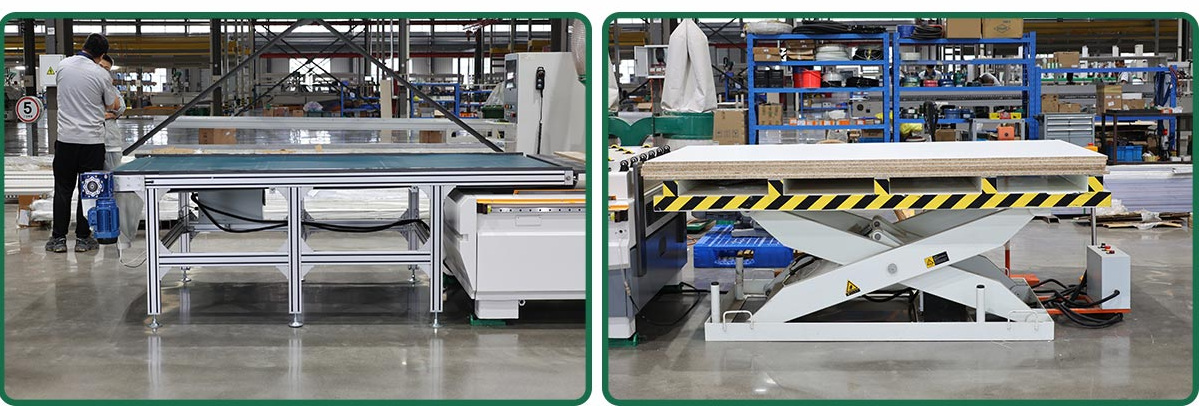
The Kenya project combines an edge banding machine with a CNC router — a mixed configuration rather than edge banding alone.
A producer in Kenya has operated a combined edge banding machine and CNC router installation for two years. This is the intermediate case: the factory did not buy a full three-station line, but it also did not stop at edge finishing. The router brought panel shaping in-house while the edge bander handled sealing and finishing. Two years of continuous operation indicates that a partial configuration built around the actual process gap — shaping plus edge finishing, without a separate side drilling station — can hold up in production.
Comparing the two projects gives buyers the useful decision pattern. The Greek workshop chose depth in one operation. The Kenyan producer chose breadth across two operations matched to its product mix. Neither bought a full configuration for its own sake, and both are described by SYUTECH as demonstrating stable operation and improved output since installation.
When the three-station configuration is the correct answer
Configuration B fits a factory whose product range is dimensionally varied, whose drilling patterns change per order, and whose assembly defects trace back to hole position or panel size rather than edge appearance. It also fits factories currently paying a subcontractor for both cutting and drilling, where the combined subcontract spend and the associated lead time are visible line items.
Comparison Table: Edge Banding Only vs Three-Station Configuration
| Decision dimension | Configuration A: edge banding only | Configuration B: edge banding + HK612B + HK330 |
|---|---|---|
| Operations performed in-house | Edge sealing and finishing only — conveying, gluing and welting, cutting, alignment, trimming, scraping, polishing | Cut-to-size, drilling and edge finishing all performed in-house |
| Dependency on external suppliers | Panels must arrive cut to size and pre-drilled | Dependency reduced to raw board supply |
| Where quality risk sits | Panel dimension and hole position inherit the supplier's tolerance | Dimension and hole position controlled at the HK330 and HK612B |
| Supporting equipment required | Air compressor, vacuum cleaner or dust extraction, vacuum pump | Supporting equipment for all three stations plus additional electrical supply and floor space |
| Compliance documentation | One CE documentation set per edge banding machine, e.g. certificate HTT202405661L with EN 60204-1:2018 and EN ISO 12100:2010 | Separate CE documentation set and electrical safety assessment for each machine |
| Throughput coupling | Output set by manual feeding against a feeding speed of 18–22–25 m/min on the HK868P | Output set by the slowest station; drilling and cutting cycle times must match edge banding demand |
| Best fit | Factories with stable, repeatable panel formats and reliable pre-cut, pre-drilled supply | Factories with varied formats, changing drilling patterns, and assembly defects traced to upstream accuracy |
| Evidence pattern | Greece: ten edge banding machines, three years of continuous operation | Kenya: edge banding plus CNC router, two years of operation — a partial-breadth precedent |
Frequently Asked Questions
Do edge banding machines, side drilling machines and panel saws each need separate CE documentation for the EU?
Yes. CE conformity applies per machine, not per workshop or per order. SYUTECH's HK series machinery is CE certified under certificate HTT202405661L, with documentation referencing EN 60204-1:2018 for electrical equipment of machines — the low-voltage safety basis — and EN ISO 12100:2010 for risk assessment. Mechanical safety for chain-fed edge banding machines is addressed by EN ISO 19085-17:2021 and ISO 18217:2015. A three-station configuration therefore requires three documentation sets, and the certificate reference should be confirmed for each unit in the quotation.
What can the HK612B side drilling machine do that an edge banding machine cannot?
Drilling. The edge banding machine performs conveying, gluing and welting, cutting, front and rear alignment, upper and lower trimming, upper and lower scraping, and polishing — it seals and finishes the panel edge and nothing else. Dowel holes, hinge positions and shelf-pin lines require a drilling station. Whether the HK612B fits a specific programme depends on three published fields: processing size, drilling tools and axis speeds. Processing size sets the panel range, drilling tools set how many hole operations complete per cycle, and axis speeds set whether the station can keep pace with the edge bander.
What drives the cost difference between an edge banding-only setup and a three-station configuration?
Three cost blocks sit behind the difference. First, the two additional machines, each carrying its own specification level in processing size, drilling tools, axis speeds, cutting height, cutting width, cutting speed and motor power. Second, the supporting infrastructure — air compressor, vacuum cleaner or dust extraction and vacuum pump are required for the edge banding station alone, and the wider configuration adds electrical supply and floor space. Third, compliance: each machine needs its own CE documentation and electrical safety assessment rather than one shared declaration. Buyers should request itemised quotations covering machines, supporting equipment and documentation separately.
Can I validate machine fit with a sample before committing to a full configuration?
Yes, and it is the recommended sequence. Send the smallest and largest panels in your cabinet programme along with your edge band width and thickness, so the supplier can confirm the 40 mm minimum panel width and the 10–60 mm band width and 0.4–3 mm thickness ranges are satisfied on the proposed model. For drilling, supply the actual hole pattern so the drilling tool arrangement can be checked against it. Sample validation should also confirm the supporting equipment specification, since air supply and dust extraction quality affect edge finish as directly as the machine does.
What lead time and installation planning should I expect for a three-station configuration?
Plan for the compliance and infrastructure work in parallel with machine production, because they run on separate timelines. Electrical supply sizing for three machines, air compressor capacity, dust extraction routing and floor space allocation all need to be resolved before delivery. SYUTECH operates a 10,000 m² facility with an annual production capacity of 500 units and exports about 80% of output, so delivery scheduling should be confirmed in writing per unit. If you want to review the full machinery range and installation requirements before finalising scope, the SYUTECH edge banding machine range and the factory catalogue are useful starting points, and the team can quote the exact configuration against your panel list.
Conclusion
An edge banding machine alone is the correct configuration when edge finishing is the constraint and panels arrive cut and drilled to a tolerance you can trust. Adding the HK612B side drilling machine and HK330 computer panel saw is the correct configuration when the losses trace back to hole position and panel dimension rather than edge quality — and when the combined subcontract spend and lead time for cutting and drilling are visible costs.
The Greece and Kenya installations show both patterns working in production: ten edge banding machines running for three years in a focused configuration, and a two-year edge banding plus CNC router project built around the actual process gap rather than a full line. Neither case suggests that buying more machines than the constraint requires is a good decision. Both suggest that the decision should follow the measured bottleneck.
Next Step: Match the Configuration to Your Panel List
Send SYUTECH your panel sizes, band width and thickness, and drilling pattern. The team can confirm whether an edge banding machine alone covers your programme, or whether the HK612B side drilling machine and HK330 computer panel saw are justified — and return an itemised quotation covering machines, supporting equipment and CE documentation.
Website: www.syutech.com | Email: zywoodmachine@163.com | WhatsApp: +86 13929919431
Further reading: Edge Banding Machine 101: Types, Specs & Applications
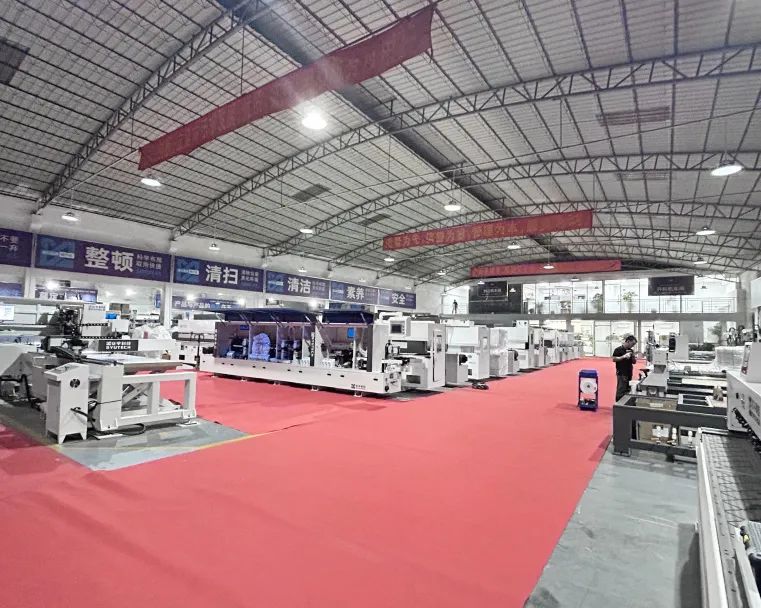
Foshan Shunde SaiYu Technology Co., Ltd. (SYUTECH) — 10,000 m² facility, 500 units annual capacity.
Have Questions or Need More Details?
Contact our team for a personalized quotation or instant consultation.
Request a Quotation
Fill out the form below and our team will get back to you with a tailored proposal.
WhatsApp Direct Chat
Prefer to chat in real-time? Message us on WhatsApp for instant assistance & quick answers.
- Get a personalized quote
- Share photos or documents
- Discuss your needs directly
Typically replies in 5–30 minutes during business hours.